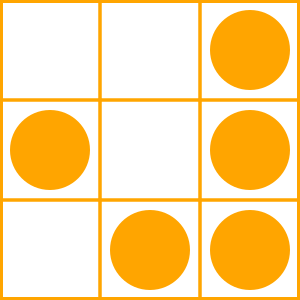
ChatGPT explains the golden ratio.
Golden Ratio
Reply

ChatGPT explains the golden ratio.
I asked ChatGPT to format php datetime as “Fri 24 Mar 2023” and it “understood” what I meant and gave me the answer that I wanted! If that’s not intelligence I don’t know what is…
ChatGPT answers the question Is it artist then title or title then artist? Its answer: Artist – Title.
Ah, click bait. Sign of the times! MEGATHREAT: Why AI Is So Dangerous & How It Could Destroy Humanity | Mo Gawdat.
Mo Gawdat is an Egyptian entrepreneur and writer. He is the former chief business officer for Google X and author of the books Solve for Happy and Scary Smart.
Mo says there are some things we shouldn’t waste time talking about because they are going to happen, inevitably. These are:
…and the fourth inevitability? Utopia..?
ChatGPT explains equivocation. Its example:
ChatGPT tells me about the Lorentz Factor.
The initialism “RTL” can stand for both “Register Transfer Level” and “Resistor-Transistor Logic” as explained by ChatGPT.
I always get the concepts “critical path” and “critical section” confused.
The “critical section” is the part in your algorithm which you must hold a lock for; whereas the “critical path” is an idea from hardware design which relates to the time taken for the longest combinatorial logic that needs to be processed during a clock cycle, thus limiting the frequency you can run your clock at.
Although the terminology “critical path” came from hardware, the same terminology is used in software. ChatGPT has a fairly good write-up on the two uses of the term “critical path”.
I learned a little more about this in Introduction to VHDL for FPGA and ASIC design.
ChatGPT is too good!
I wanted a new logo to go with my YouTube channel to replace a very old photo of me. So I asked ChatGPT and it didn’t let me down!