
Homework

This is a part of the homework feature of my blog, which is an ongoing conversation with my mate S.F.

Hey mate. Lovely to see you again, as always. Can’t wait to do it all again soon!

Two interesting movies I’ve seen lately:

The prompt for my breathing timer which I gave to ChatGPT, was: “please create a web page for me with HTML and JavaScript that I can use for breathing techniques. I want two modes: box breathing which is in for 4 seconds, hold for 4 seconds, out for 4 seconds; and 4 – 7 – 8 which is in for 4 seconds, hold for 7 seconds, out for 8 seconds. I should be able to pick the mode I want and then the app will prompt me with timers about what to do next.”

The hard problem of consciousness is one of the most profound unsolved questions in philosophy and cognitive science. It asks why and how does physical activity in the brain give rise to subjective experience? In other words, why does it feel like something to be conscious? I’m not sure of course, but it seems to me that the capacity for memory is tied up with consciousness, inasmuch as we don’t seem to have memory without first having been conscious.

Cartesian doubt is a form of methodological skepticism associated with the writings and methodology of René Descartes, the idea being that we can find things which are indubitable, that is, beyond doubt. Descartes famously found “I think, therefore I am.” That he could think was an indubitable fact. I have a similar thing which I like that is: “I know that I am having a sense experience”. It’s kind of along the same lines but includes more primitive conceptions, such as knowledge, time, identity, sensation, and such.

Conclave (2024) was an interesting film about the election of the pope. It’s fiction and you don’t need to be a true believer to enjoy the movie.

We mentioned about Pamela Anderson, and her movie Pamela, a Love Story is on my list. Pamela was at one point married to Tommy Lee of Mötley Crüe fame.

You recommended The King of Kong (2007) and I recommended Ready Player One (2018).

We discussed the Pareto distribution which is a type of power law distribution. These types of distributions can mess with our intuitions because they are not similar to bell curves or other less extreme distributions. The Pareto distribution gives rise to the “80:20 rule” where 80% of outcomes are for 20% of causes.
Homework

This is a part of the homework feature of my blog, which is an ongoing conversation with my mate S.F.

Hey mate. Lovely to see you again, as always. Can’t wait to do it all again soon!

We spoke about Live on Brighton Beach by Fatboy Slim.

I mentioned I’ve been watching videos from Rabbi Simon Jacobson at Meaningful Life Center.

Band name: Healthy Advice for Living.

Band name: Threaten to Fall.

I mentioned about Speed Racer by the The Wachowskis.

You mentioned about the Safe Space in Katoomba.

I mentioned about Elle Cordova. She’s super creative and has made some great videos, particularly her Errorist series, starting here: Grammarian vs Errorist – a supervillain showdown. I’ve mentioned about her before.

I mentioned about Mindform which is a sort of self-improvement community I participate in. It’s run by Ryan Bush who has written a few books including Designing the Mind: The Principles of Psychitecture.

I mentioned about my bullet journal. It is now an instrumental part of my whole day and I can barely imagine how I used to live without it. I got myself one of the official bullet journals too, it’s great; well made and full of thoughtful and practical features.

I mentioned about this SMBC comic: your ethical system is nuts, man!

You mentioned about Information is Beautiful.

You mentioned about Alain de Botton on The Diary of a CEO: The Love Expert: The REAL Reason We’re Lonely, Loveless, Depressed – Alain De Botton, School Of Life.

We listened to Careless Whisper by George Michael.

I mentioned about Iron Sky which is a silly film but a bit of fun.

You mentioned about the Frame problem which is also taken up by Stanford Encyclopedia of Philosophy: The Frame Problem.

You suggested intermittent fasting.

Homework

This is a part of the homework feature of my blog, which is an ongoing conversation with my mate S.F.

Hey mate. Lovely to see you again, as always. Can’t wait to do it all again soon!

I have a note here for “Odd Socks”, but I don’t remember what that was about. Do you?

I mentioned about Elle Cordova. She’s made some really creative and humorous YouTube videos including Grammarian vs Errorist.

You mentioned about Eternal Sunshine of the Spotless Mind.

The sublime is a way of simplifying what you don’t understand.

You mentioned The Road to Wigan Pier by George Orwell.

“Ideas are like fish. If you want to catch little fish, you can stay in the shallow water. But if you want to catch the big fish, you’ve got to go deeper. Down deep the fish are more powerful and more pure. They’re huge and abstract. And they’re very beautiful.” — David Lynch on Big Ideas. In fact he wrote a book titled Catching the Big Fish.

I mentioned about the Sex Ed Sketch from Monty Python’s Meaning of Life. Speaking of Monty Python there was also medical experiments for the lot of you.

I mentioned about Chesterton’s fence which is the principle that reforms should not be made until the reasoning behind the existing state of affairs is understood.

I mentioned about Cantor’s diagonal argument. This method can be used to construct the more numerous real numbers from the rationals.

My essay on Cartesian Dualism is here: 2008-2-PHI130.Essay.2.

I mentioned this humorous sketch: They’re Made Out Of Meat.

Homework

This is a part of the homework feature of my blog, which is an ongoing conversation with my mate S.F.

Hey mate. Lovely to see you again, as always. Can’t wait to do it all again soon!

A film to check out is Materialists, it’s a bit of fun. Another interesting film is Conclave. And also The Green Knight.

The video where I explain my maths homework is here: Channel News #10: Happy New Year! | Learning Electronics In The Lab With Jay Jay.

This song by the Sex Pistols from back in 1978 is Friggin’ in the Riggin’. Everyone should know this one!

You mentioned Blue Velvet by David Lynch.

I thought it was Cars that was by The Wachowskis but the film I was thinking of was Speed Racer.

You explained lens speed to me.

You mentioned about the film Pirates of Silicon Valley.

I created a bunch of applets to help me practice my arithmetic:

I mentioned about Chase Hughes. He has a bunch of interesting videos. I particularly enjoyed this one: How to WIN the Game of Earth. If you have more time this one is also good: How They Broke us All.

I mentioned I am reading the “classics”. In this case classic open source software, the details are here: Classics.

I mentioned about Ryan Bush who is the person behind Designing the Mind.

The word superordinate means both “of higher rank, status, or value” and “of or being the relation of a broader category to a narrower category that it encompasses, such as metal in relation to iron.”

I mentioned this comic about David Hume: David Hume on Creativity. The idea is that all ideas are combinations and relations of antecedent ideas and there isn’t any genuine “creativity”. Of course that would imply some type of axiomatic ideas or else you could never break into the system…

Homework

This is a part of the homework feature of my blog, which is an ongoing conversation with my mate S.F.

Hey mate. Lovely to see you again, as always. Sorry it took me so long to get this homework written up!

Tyke is a slang term for Catholic.

The book about zero is: Zero: The Biography of a Dangerous Idea, I will get you a copy.

Andrew Bustamante is the EverydaySpy. I really think he shouldn’t be doing what he is doing. Businesses shouldn’t use the techniques of clandestine belligerent organizations like the CIA.

Chase Hughes is an interesting cat.

HeForShe, referred to as He for She, is a solidarity movement for the advancement of gender equality initiated by the United Nations. On the web here: https://www.heforshe.org/en.

There are many books written by Kamala Harris. I haven’t read any of them, yet.

The “political compass” is the idea that there are two dimensions to a person’s politics: economic and social. To find out which quadrant you’re in you can take the test.

Hope is not a strategy.

The Bureau of Meteorology upgraded their website for $96.5m and managed to upset a lot of people.

Mel Robbins made a name for herself as a blogger and internet personality. She talks about personal development and things like that.

The “phono out” is an unamplified signal coming out of a record player and “line in” is an input for a signal which is already amplified to “line level”.

You recommended Planet America.

The classic send up of form over substance in academia is: Chicken chicken chicken.

Nirvana Unplugged in New York.

Grammarian vs Errorist – a supervillain showdown is among the best of what the internet has to offer. @ElleCordova makes great stuff.

The nbn options in roughly decreasing order of signal speed and reliability:

  • Fibre to the Premises (FTTP), Fibre-optic cable runs all the way from the network to your house.
  • Fibre to the Curb (FTTC), Fibre runs close — to a pit or junction near your street (the “curb”), then a short length of copper connects to your home.
  • Fibre to the Node (FTTN), Fibre runs to a street cabinet (node), then copper phone lines connect each home.
  • Fibre to the Building (FTTB), Fibre goes to a basement or comms room of a unit/apartment building, then internal copper wiring serves individual units.
  • Hybrid Fibre-Coaxial (HFC), Fibre optic to the street, then coaxial cable (often old cable TV wiring) to the home.
  • Fixed Wireless (FW), Wireless signal from a nearby transmission tower to an antenna installed on your roof.
  • Satellite (e.g., Sky Muster), Internet is beamed to/from communications satellites (e.g., Sky Muster) for remote areas.

South Park lampooned Melania Trump.

Phase one: collect underpants.

The winner of 2025 Component Abuse Challenge was LED candles.

Altronics is an Australian electronics reseller. They have a brand of industrial electronics equipment Redback.

If you’re interested in human intelligence you should read about Cattell–Horn–Carroll theory. CHC is a psychological theory on the structure of human cognitive abilities.

You mentioned about Point Counter Point, a novel by Aldous Huxley, first published in 1928.

You mentioned about Foundation, a science fiction novel series written by American author Isaac Asimov.

I mentioned about The Master and His Emissary: The Divided Brain and the Making of the Western World.

The idea behind reductio ad absurdum is the idea that if your proof leads to an absurdity in cannot be valid.

The Greek mathematician Euclid wrote the second best selling book ever written, Elements. Second only to the bible.

The curse of knowledge is a cognitive bias where people who are experts assume others know what they do (but they don’t!).

The 2009 film The Invention of Lying starring Ricky Gervais is hilarious.

Homework

This is a part of the homework feature of my blog, which is an ongoing conversation with my mate S.F.

Hey mate. Lovely to see you again, as always.

It was Nietzsche who said: “He who has a why to live can bear almost any how.”

Wikipedia explains the Chinese room argument:

The Chinese room argument holds that a computer executing a program cannot have a mind, understanding, or consciousness, regardless of how intelligently or human-like the program may make the computer behave. The argument was presented in a 1980 paper by the philosopher John Searle entitled “Minds, Brains, and Programs” and published in the journal Behavioral and Brain Sciences. Before Searle, similar arguments had been presented by figures including Gottfried Wilhelm Leibniz (1714), Anatoly Dneprov (1961), Lawrence Davis (1974) and Ned Block (1978). Searle’s version has been widely discussed in the years since. The centerpiece of Searle’s argument is a thought experiment known as the Chinese room.

In the thought experiment, Searle imagines a person who does not understand Chinese isolated in a room with a book containing detailed instructions for manipulating Chinese symbols. When Chinese text is passed into the room, the person follows the book’s instructions to produce Chinese symbols that, to fluent Chinese speakers outside the room, appear to be appropriate responses. According to Searle, the person is just following syntactic rules without semantic comprehension, and neither the human nor the room as a whole understands Chinese. He contends that when computers execute programs, they are similarly just applying syntactic rules without any real understanding or thinking.

Personally, I don’t buy the Chinese room argument. I think you can have genuine semantic understanding even in the context of a wholly symbolic reality or experience. Indeed, I think our own semantic understandings are essentially that. That is, I think our semantic understandings can probably be reduced to symbols and are certainly mediated by them. To my mind our brains are obviously machines, thus machines can do what we can do. Do machines have to be brain-like in order to succeed? I doubt it. Both birds and aeroplanes can fly.

The Gettysburg Address is a famous speech that was delivered by Abraham Lincoln, the 16th U.S. president, following the Battle of Gettysburg during the American Civil War in 1863 (161 years ago). The speech has come to be viewed as one of the most famous, enduring, and historically significant speeches in American history. Peter Norvig did a hilarious send up of this famous speech as a series of powerpoint slides as an example of how terrible such slides can be: The Gettysburg Powerpoint Presentation.

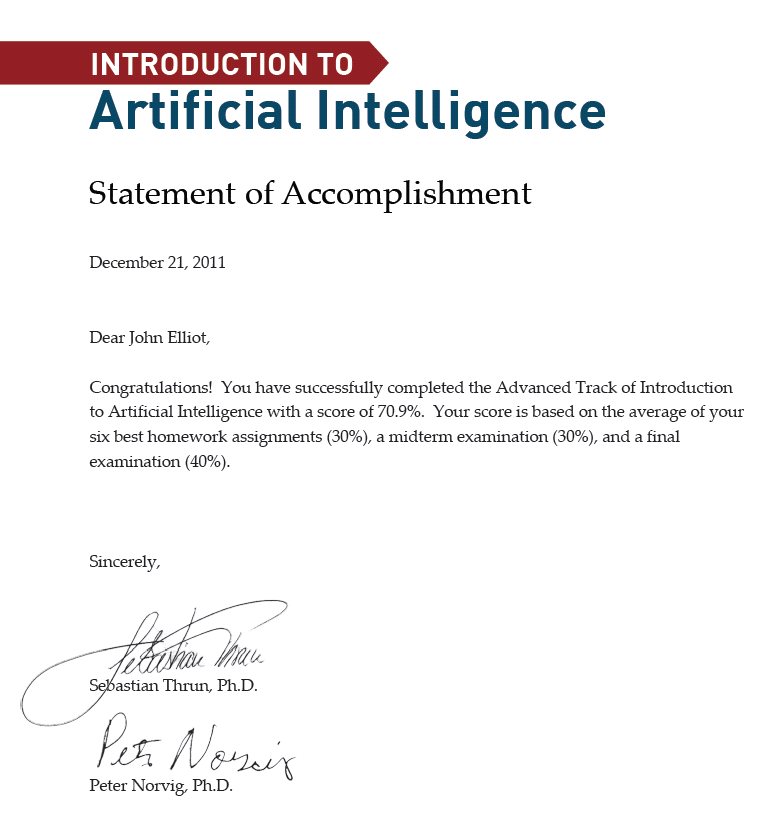
Back in 2011 Peter Norvig and Sebastian Thrun taught an online course with over 100,000 students in attendance. Including me! Norvig spoke about the project in his 2012 TED Talk: The 100,000-student classroom.

I have a note here regarding fractionation, but I’m not sure why that was relevant? It must have come up in our discussion?

The welcome video for my YouTube channel is this one: Welcome to @InTheLabWithJayJay! An Electronics Video Blog.

You mentioned the concept of low-GI joy. As compared with, I suppose, hi-carb joy. I suppose this is what the Stoics were on about.

From Alan Watts:

You see, I’m not talking about a philosophy. I’m not talking about a rationalization, some sort of theory that somebody cooked up in order to explain the world and make it seem a tolerable place to live in. I’m talking about a rather whimsical, unpredictable experience that suddenly hits people and it includes this element of feeling the total harmoniousness of everything.

Check out Garys Economics. A former trader explains economics to the layperson.

Olivetti is the famous Italian company which made typewriters and computers back in the day. In this video they show you how everything is now abandoned and run down: The Downfall of Olivetti – Exploring an Abandoned Computer Factory. (Note: this made me think of the recent destruction at the Paragon in Katoomba.)

Homework

This is a part of the homework feature of my blog, which is an ongoing conversation with my mate S.F.

Hey mate. Lovely to see you again, as always.

I have a note here about Milo but I’m not sure why.

There is a rumor that the story of Snow White and the Seven Dwarfs is about cocaine addiction, particularly that the Seven Dwarfs represent the various stages. But Snopes says this theory is bunk.

Two authors Strunk & White wrote a book called The Elements of Style which is a style guide for formal grammar used in American English writing. Famously they said “let every word tell”.

The phone you gave me I named ‘skadi’ after the Norse goddess Skaði.

According to John Cleese in his hilarious letter Something of a Retraction: Cleese letter to the U.S., French fries aren’t French, they’re Belgian.

I heard a rumour that DeepSeek says there are three r’s in “strawberry” but I can’t find a corroborating source.

Penny Arcade is great. I mentioned this one: Dirty One.

In Laws and Sausages the structure of the United States of America is explained in a comic format.

In Death of a Salesman there is a famous quote “A salesman is got to dream. It comes with the territory.”

Tribal not racist.

I think all you need for subjective experience is one or more sensors. Both consciousness and self-awareness are different to that. Although they probably do entail subjective experience too.

I should have a promotions policy on my website. Thanks for the suggestion. I will look into this.

There is a famous RFC: Key words for use in RFCs to Indicate Requirement Levels. This, for instance, defines what the word “should” should mean.

The seven check marks are elements of white privilege, given as:

  1. male
  2. white
  3. heterosexual
  4. at least one highly educated or wealthy parent
  5. at least one parent born in the Netherlands
  6. a VWO diploma (preparatory scientific education)
  7. and a diploma from the University

In Outliers the author Malcolm Gladwell comes to the conclusion that success is mostly luck. In the same book Gladwell says that to attain mastery the a subject needs to be actively studied for 10,000 hours.

In Magic Words and How to Use Them the author explains how you can use uncompromising positivity to craft the life you want. Seemed to work for me, if you’re positive about people they seem to magically be positive back.

The Old New Thing is a blog from Raymond Chen, a long time programmer from Microsoft who had a lot to do with Windows.

I mentioned that Alan Kay worked for both Atari and Apple.

The famous quote “Never underestimate the bandwidth of a station wagon full of tapes hurtling down the highway.” is from Andrew S. Tanenbaum.

Asleep From Day by The Chemical Brothers.

Why You Will Marry the Wrong Person from Alain de Botton.

Before you speak let your words pass through three gates:

  1. is it true?
  2. is it necessary?
  3. is it kind?

Homework

This is a part of the homework feature of my blog, which is an ongoing conversation with my mate S.F.

Hey mate. Lovely to see you again, as always.

You told me about Gorilla Glue. Rather unhelpfully there are all different types.

I mentioned my manifesto. Everyone should have one. :)

The Everyday Spy is Andrew Bustamante.

A PhD involves a thesis defense.

I have a note here “star app”, but I’m not sure what it refers to? Do you remember? I did search for “star app“.

This is required viewing: Bogans.

See you again soon! <3

Homework

This is a part of the homework feature of my blog, which is an ongoing conversation with my mate S.F.

Hey mate. Lovely to see you again, as always.

First, two things from last time which I forgot to write up:

I mentioned Veritasium which is a video blog of interest.

I have a note here that says “ASI”. And that’s all it says. Not sure what that was about?

I did consider writing my response to Mark Fisher‘s work Capitalist Realism (which is available on the web here), but in researching him and his work this evening I have learned that he died by suicide in 2017. I think suicide is the worst thing ever and I can’t bring myself to write something which tears strips off people who are no longer here to respond. (I intend to read Mark’s PhD thesis Flatline constructs: Gothic materialism and cybernetic theory-fiction.)

You mentioned Pick of the Litter, noting that dogs are trained to sometimes ignore the command of their master, particularly when it wouldn’t be safe.

One good thing about arguments with friends is that there is always time to pee.

Norvig’s Law: Any technology that surpasses 50% penetration will never double again (in any number of months).

This marketing dude Rory Sutherland is actually quite impressive. I hadn’t expected as much from someone in advertising! He has given a number of TED talks and there are many interviews with him on YouTube.

The documentary about the 2008 financial crisis that I mentioned was Inside Job. Not to be confused with the TV series with the same name (which is excellent, by the way).

My favorite philosopher of the day is Iain McGilchrist. I suspect my own beliefs and preferences diverge from those of McGilchrist but I do really enjoy his thought. I have watched a number of interviews with Iain McGilchrist. He has written a number of books, a few of which I have purchased and intend to read: The Matter With Things: Our Brains, Our Delusions and the Unmaking of the World, The Master and His Emissary: The Divided Brain and the Making of the Western World, and The Divided Brain and the Search for Meaning.

The book Thinking, Fast and Slow by psychologist Daniel Kahneman demarcates two systems of thinking: one fast and automatic, the other slow and deliberative.

The quotation “the stupid are cocksure, while the intelligent are full of doubt” is variously attributed (including to Bertrand Russell).

Check out Mr Inbetween, it’s really excellent!

Love you my brother, see you on Christmas Day! <3

Homework

This is a part of the homework feature of my blog, which is an ongoing conversation with my mate S.F.

Hey mate. Lovely to see you again, as always.

You mentioned this paradoxical thought: “Grieving the loss of something you don’t want back.”

One thing about evil is that it only cares about itself; it doesn’t care about you.

The RAND Corporation is an American think tank and the name “RAND” is from “Research ANd Development”, I don’t believe it has anything to do with Ayn Rand. The RAND Corporation is the first entity to be called “think tank”, it defined the category.

The parody metal band I mentioned, in the spirit of Spinal Tap, is Ten Times Your Master. Check it out, it’s pretty funny. :P

ur an aligned philosopher

Capitalist Realism: Is There No Alternative? is a 2009 book by British philosopher Mark Fisher. It explores Fisher’s concept of “capitalist realism”, which he describes as “the widespread sense that not only is capitalism the only viable political and economic system, but also that it is now impossible even to imagine a coherent alternative to it.” This book is available on archive.org.

My theory about contradiction is that when someone becomes aware of a contradiction they can either:

  • Laugh
  • Cry
  • Deny

Well adjusted people laugh. Some people get sad. Others suffer cognitive dissonance and deny.

But as you say some people just “don’t get it” and never become aware of the contradiction.

My theory is that at the heart of all humour is a contradiction, and not everyone will choose to laugh when they see the contradiction, some people will get upset about it or refuse it.

I have a note here “consistency with variation”, I think we decided that was a good idea?

David Graeber wrote a book called Debt: The First 5,000 Years. He presents his ideas in this video: Debt: The First 5,000 Years | David Graeber | Talks at Google.

When we were chatting I said that the father of Subjective Idealism was Bertrand Russell but of course it was George Berkeley.

Look forward to seeing you again soon! <3