Oh man, Elle Cordova is so insanely creative. It’s gonna be a long time before the AI puts her out of work! This recent one was brilliant: Grammarian vs Errorist II (it’s part II in Grammarian vs Errorist series). Here’s my favorite so far: Virtual Assistants.
Category Archives: Inspiration
Spectrum Analyzer using Beaglebone Black and RTL-SDR
I want to build myself one of these: Spectrum Analyzer using Beaglebone Black and RTL-SDR.
RustyMeter for OWON XDM1041
Today while watching Ultimate Trace Repair Guide for Ripped Connectors I learned about RustyMeter which will work with my OWON XDM1041 multimeter. I’m definitely going to be checking that out soon. Thanks to nanofix for the tip!
Homework
This is a part of the homework feature of my blog, which is an ongoing conversation with my mate S.F.
Hey mate. Lovely to see you again, as always.
It was Nietzsche who said: “He who has a why to live can bear almost any how.”
Wikipedia explains the Chinese room argument:
The Chinese room argument holds that a computer executing a program cannot have a mind, understanding, or consciousness, regardless of how intelligently or human-like the program may make the computer behave. The argument was presented in a 1980 paper by the philosopher John Searle entitled “Minds, Brains, and Programs” and published in the journal Behavioral and Brain Sciences. Before Searle, similar arguments had been presented by figures including Gottfried Wilhelm Leibniz (1714), Anatoly Dneprov (1961), Lawrence Davis (1974) and Ned Block (1978). Searle’s version has been widely discussed in the years since. The centerpiece of Searle’s argument is a thought experiment known as the Chinese room.
In the thought experiment, Searle imagines a person who does not understand Chinese isolated in a room with a book containing detailed instructions for manipulating Chinese symbols. When Chinese text is passed into the room, the person follows the book’s instructions to produce Chinese symbols that, to fluent Chinese speakers outside the room, appear to be appropriate responses. According to Searle, the person is just following syntactic rules without semantic comprehension, and neither the human nor the room as a whole understands Chinese. He contends that when computers execute programs, they are similarly just applying syntactic rules without any real understanding or thinking.
Personally, I don’t buy the Chinese room argument. I think you can have genuine semantic understanding even in the context of a wholly symbolic reality or experience. Indeed, I think our own semantic understandings are essentially that. That is, I think our semantic understandings can probably be reduced to symbols and are certainly mediated by them. To my mind our brains are obviously machines, thus machines can do what we can do. Do machines have to be brain-like in order to succeed? I doubt it. Both birds and aeroplanes can fly.
The Gettysburg Address is a famous speech that was delivered by Abraham Lincoln, the 16th U.S. president, following the Battle of Gettysburg during the American Civil War in 1863 (161 years ago). The speech has come to be viewed as one of the most famous, enduring, and historically significant speeches in American history. Peter Norvig did a hilarious send up of this famous speech as a series of powerpoint slides as an example of how terrible such slides can be: The Gettysburg Powerpoint Presentation.
Back in 2011 Peter Norvig and Sebastian Thrun taught an online course with over 100,000 students in attendance. Including me! Norvig spoke about the project in his 2012 TED Talk: The 100,000-student classroom.
I have a note here regarding fractionation, but I’m not sure why that was relevant? It must have come up in our discussion?
The welcome video for my YouTube channel is this one: Welcome to @InTheLabWithJayJay! An Electronics Video Blog.
You mentioned the concept of low-GI joy. As compared with, I suppose, hi-carb joy. I suppose this is what the Stoics were on about.
From Alan Watts:
You see, I’m not talking about a philosophy. I’m not talking about a rationalization, some sort of theory that somebody cooked up in order to explain the world and make it seem a tolerable place to live in. I’m talking about a rather whimsical, unpredictable experience that suddenly hits people and it includes this element of feeling the total harmoniousness of everything.
Check out Garys Economics. A former trader explains economics to the layperson.
Olivetti is the famous Italian company which made typewriters and computers back in the day. In this video they show you how everything is now abandoned and run down: The Downfall of Olivetti – Exploring an Abandoned Computer Factory. (Note: this made me think of the recent destruction at the Paragon in Katoomba.)
Happy snap
How To Easily Program The ATtiny85
This is a note for Future John. I found this no-nonsense video about how to program the ATtiny85 using an Arduino: How To Easily Program The Attiny85
Rockbox 4.0 Released
I have a new post on Hackaday: Rockbox 4.0 Released.
TODO: make this power box
I saw this great power box over on Zynq-7000 PCB Build – Part 12 – Starting with Power Rails. I’m gonna make one! Or two!
Making A Variable Speed Disc Sander From An Old Hard Drive
I have a new post on Hackaday: Making A Variable Speed Disc Sander From An Old Hard Drive.
Happy April Fool’s Day
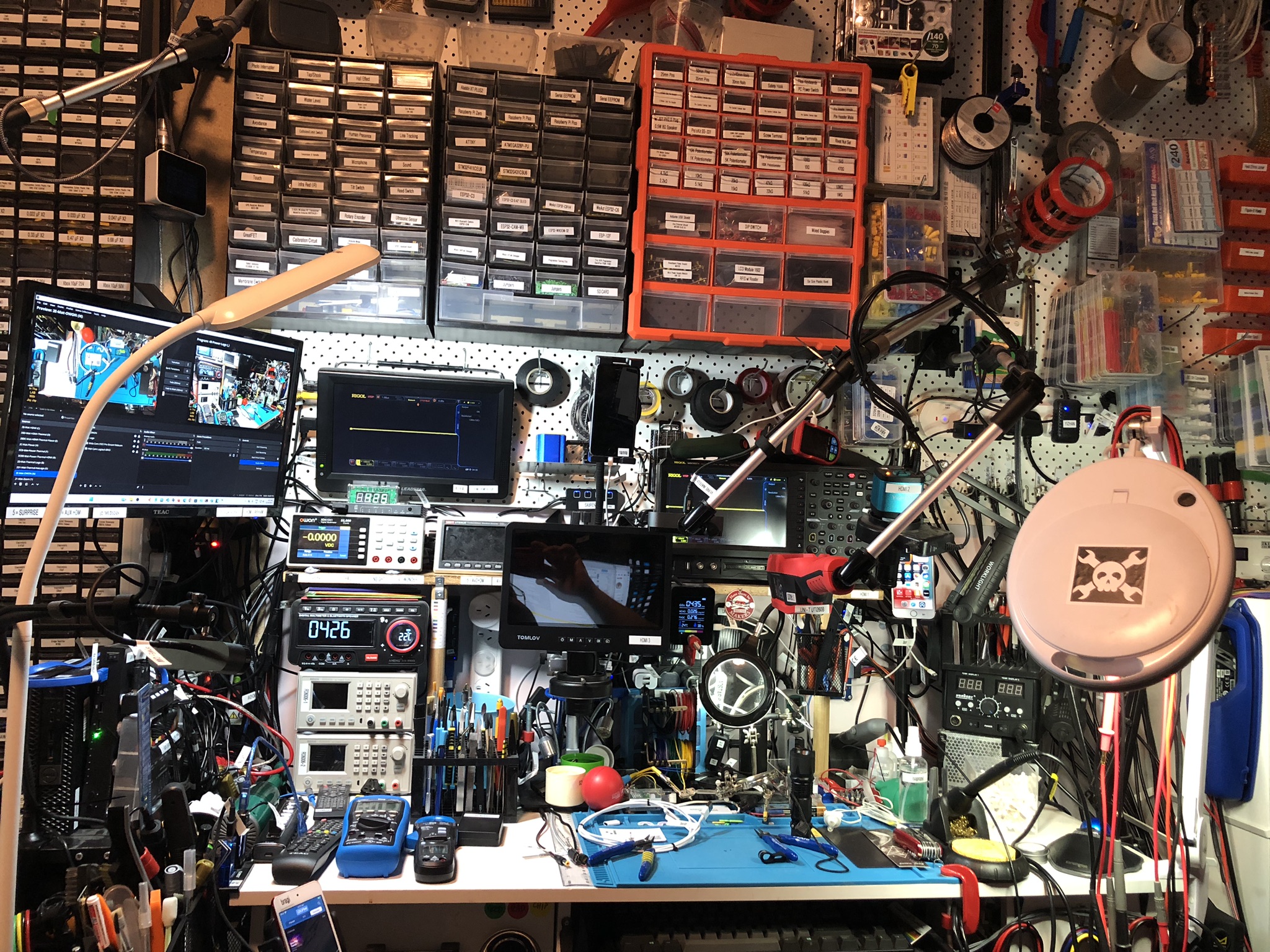
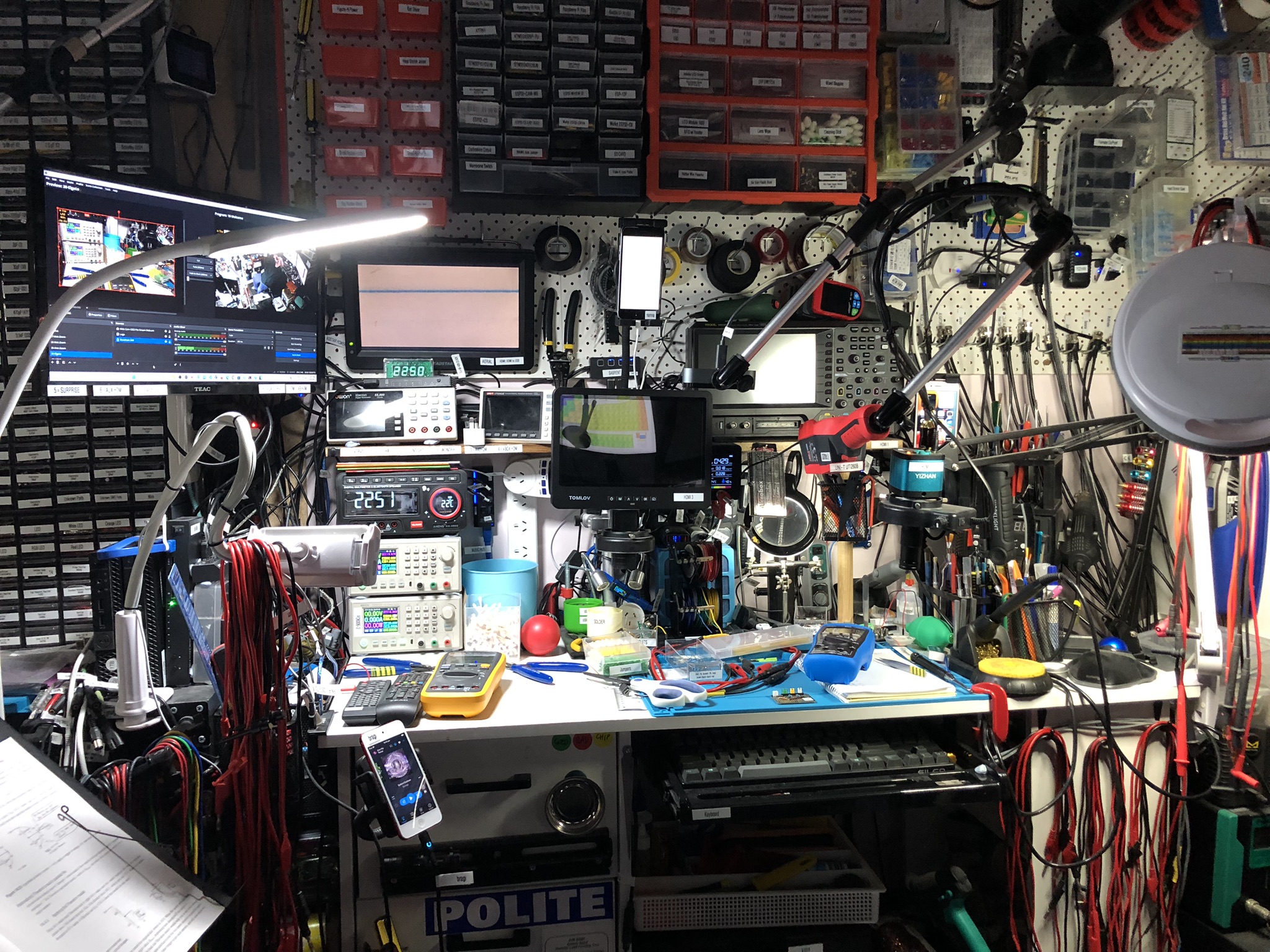
Here’s me in the lab recording a New Book Teardown for Electricity and Magnetism this April Fool’s Day.