I have an item on my TODO list to make a program to convert text into Title Case. On a whim, I asked ChatGPT to do this for me, and it did! ChatGPT is automating me out of work!
ChatGPT Title Case awesomeness
Reply

I have an item on my TODO list to make a program to convert text into Title Case. On a whim, I asked ChatGPT to do this for me, and it did! ChatGPT is automating me out of work!
This post is part of my video blog and you can find more information about this video on this show’s homepage which is here.
You can support this channel on Patreon: patreon.com/JohnElliotV
In this video I unbox two “different” helping hands (AKA “third hand”) only to discover they are the same TE-801 model.
I purchased these separately on AliExpress:
They are exactly the same product so if you’re planning to purchase might as well get the cheapest option. Note that the first link above also has a separate more expensive option which is actually a different product, I didn’t get one of those.
In addition to unboxing these third hands I also add some 4mm heat shrink to the alligator clips to take the bite out of the teeth.
Note: in this video I have the annoying habit of calling “heat shrink”, “shrink wrap”. The correct term is heat shrink, shrink wrap is a different type of thing.
In the video I use 4mm yellow heat shrink:
The hot air gun I use is a part of my Horusdy Soldering Station.
The batteries I use are Duracell AAA batteries.
My gloves are:
Thanks very much for watching! And please remember to hit like and subscribe!
Following is a product I use picked at random from my collection which may appear in my videos. Clicking through on this to find and click on the green affiliate links before purchasing from eBay or AliExpress is a great way to support the channel at no cost to you. Thanks!
ENGINEER PA-09 Crimping Tool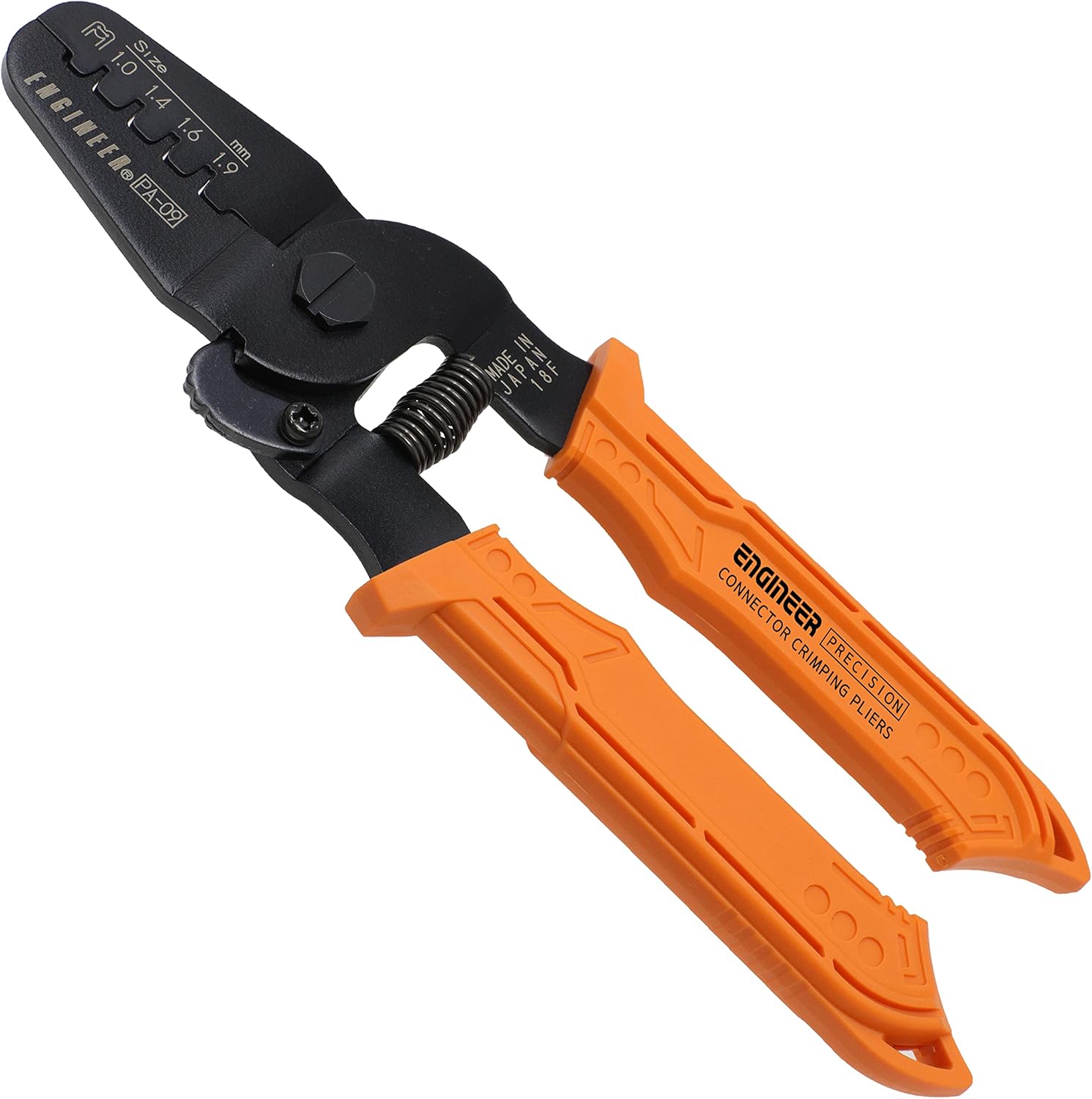 notes notes |
Let’s go shopping!
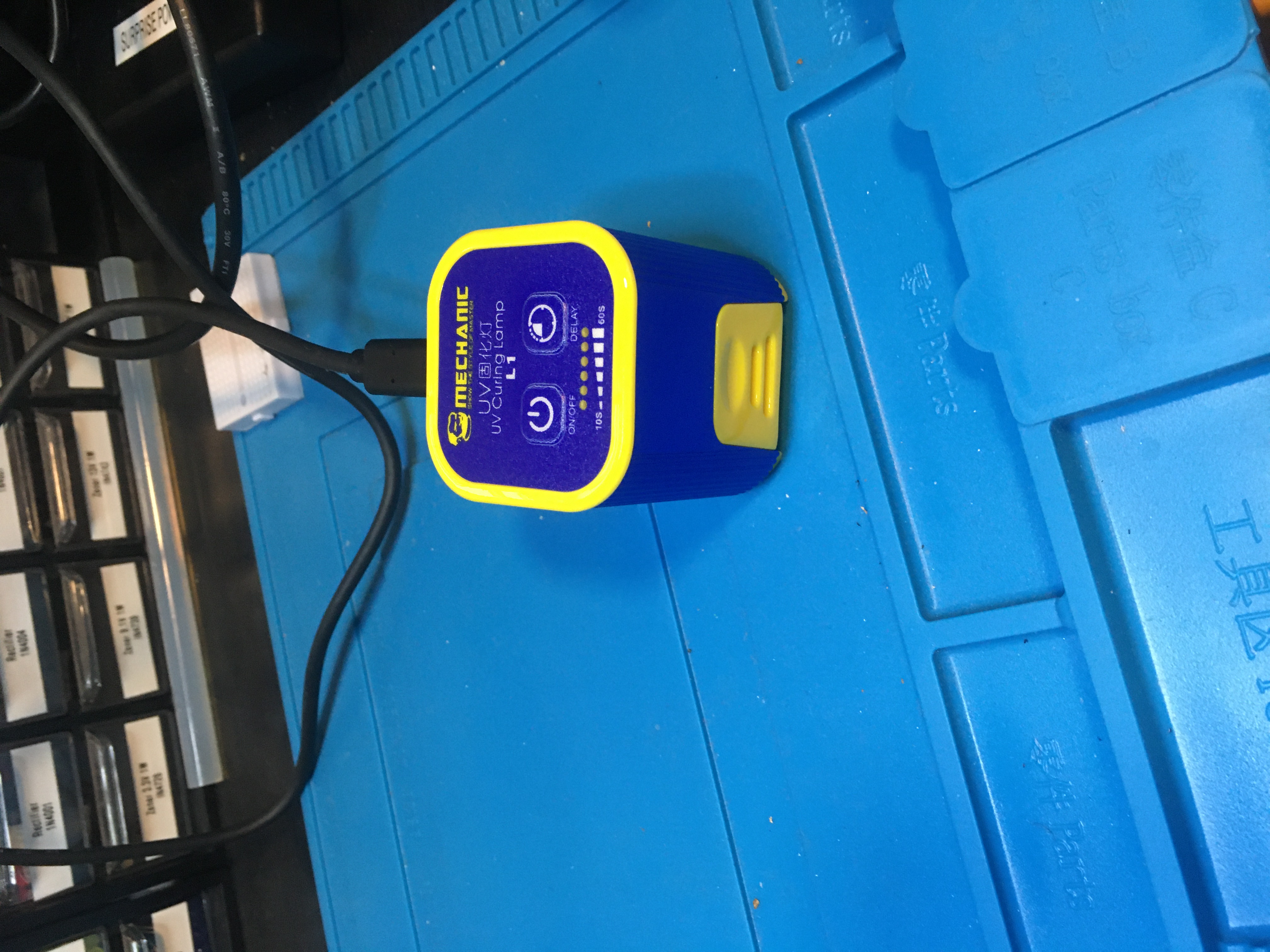
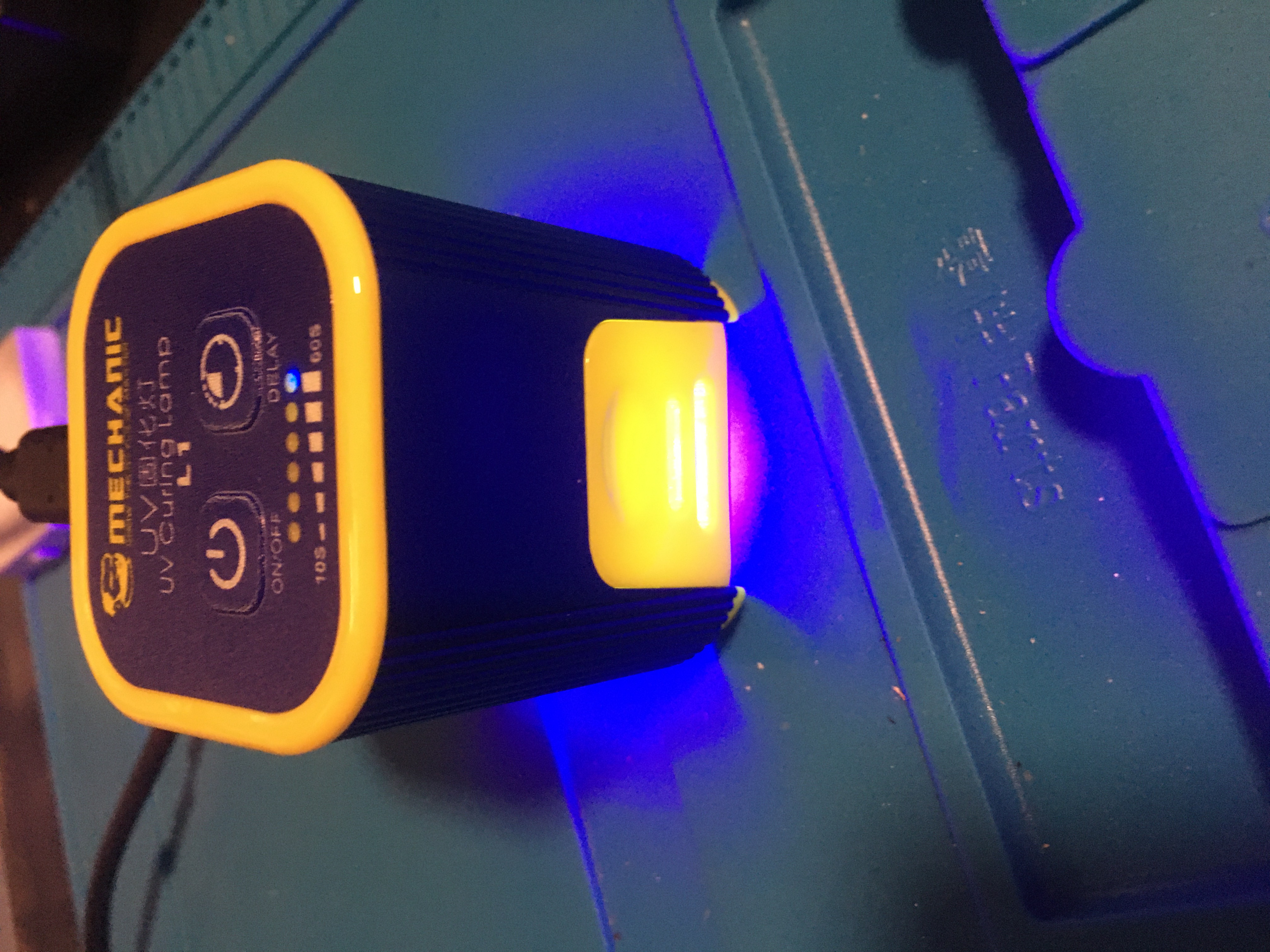
Got myself a USB powered UV light. It came with a few tubes of solder mask:
I’m gonna keep this in my booth where it will be used. Don’t want to use it anywhere near where I keep my UV solder mask because I don’t want to accidentally cure it!
This post is part of my video blog and you can find more information about this video on this show’s homepage which is here.
You can support this channel on Patreon: patreon.com/JohnElliotV
In this video I solder three different sized bodge wires onto some perfboard for practice and for the purpose of exposition. After attaching the three bodge wires I cover them with UV solder mask.
If you haven’t heard of the expression “bodge wire” before, ChatGPT will explain.
I want to thank my mate Bruce from Branchus Creations for recommending the enameled wire of various sizes, the Swann Morton blades, and the Amtech flux.
I got three rolls of this enameled copper wire from AliExpress:
The diameters of the various rolls I got were:
| Size | mm | inches |
|---|---|---|
| Small | 0.07mm | 0.003″ |
| Medium | 0.16mm | 0.006″ |
| Large | 0.31mm | 0.012″ |
I got the “coppery” colour, not the red stuff.
The Swann Morton blade handles I got were these:
I got three types of blades in #15C, #15, and #10 sizes:
The #15C Swann Morton blade is the smallest and is so far my favourite. The #15C is the blade I use in this video.
My flux is:
The industrial/precision tweezers I mention in the video are these:
The solder lugs I refer to are these:
The perfboard I used in this video was a 2x8cm board which I picked up from AliExpress:
I use two microscopes in this video:
In the video I reference my thermal imager:
My gloves are:
My head-mounted magnifying glasses are:
The soldering iron I use in this video is a part of my Horusdy soldering station:
My desoldering pump came in this kit:
The solder mask I ordered was this green stuff, but the stuff they actually sent me was red:
The solder I use in this video is:
My paint brush is the 5/0 sized brush from this set:
The blow torch I mention in this video is this one:
My Kapton tape and tape dispenser are these:
The bench multimeter I use in the video is a:
The isopropyl (IPA) alcohol I use in this video is this stuff:
Thanks very much for watching! And please remember to hit like and subscribe!
Following is a product I use picked at random from my collection which may appear in my videos. Clicking through on this to find and click on the green affiliate links before purchasing from eBay or AliExpress is a great way to support the channel at no cost to you. Thanks!
Amazon Basics Ratchet Screwdriver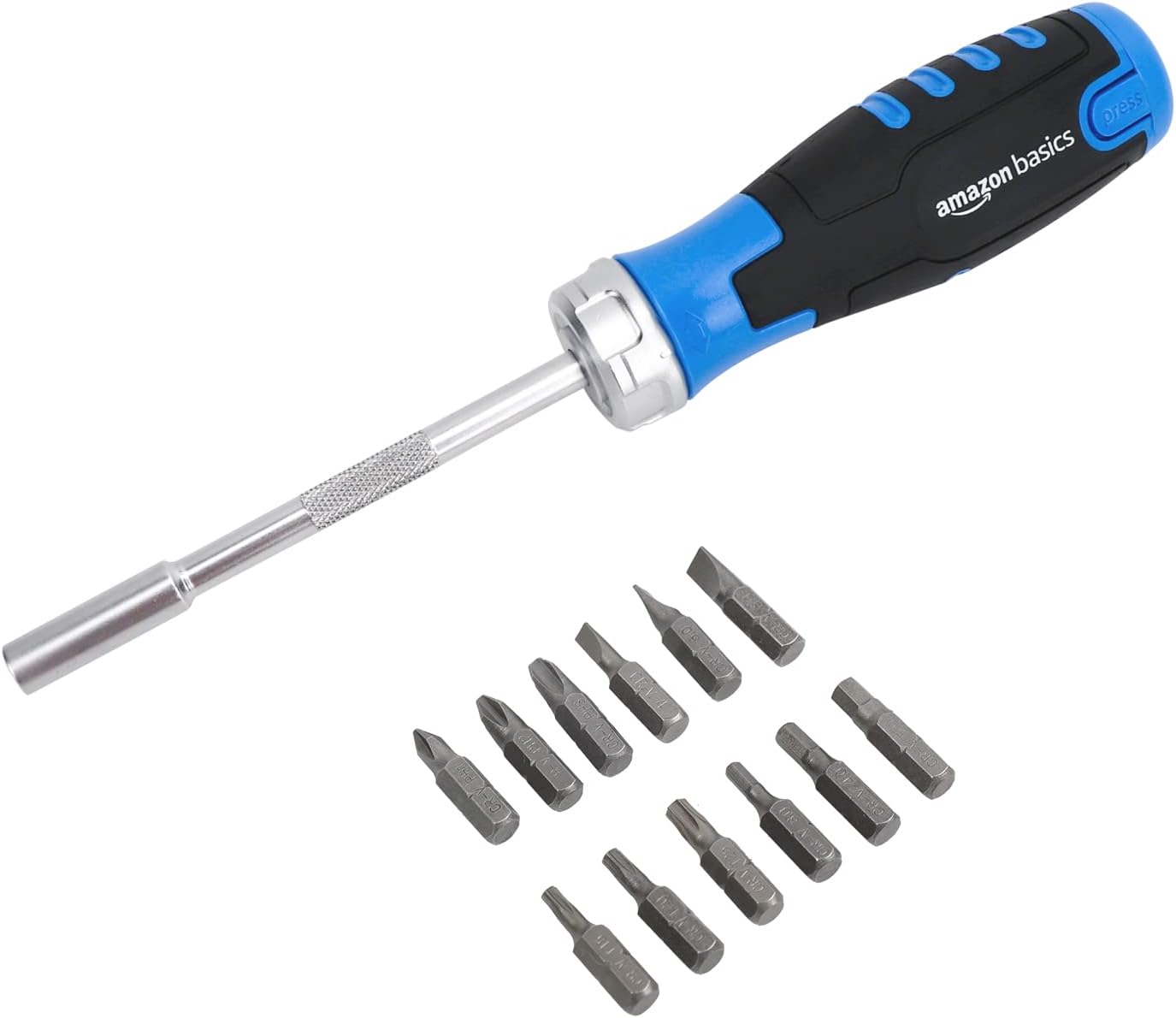 notes notes |
Let’s go shopping!
I was watching Computers running very slow, long boot time, unresponsive in windows. Let’s fix it. and Richard said that if your CMOS battery reads less than 3V then you should replace it.
I have a working theory that you can tell how good an electrical engineer is by the type of soldering iron tip they use.
And no one uses a knife tip, I mean come on, be serious.
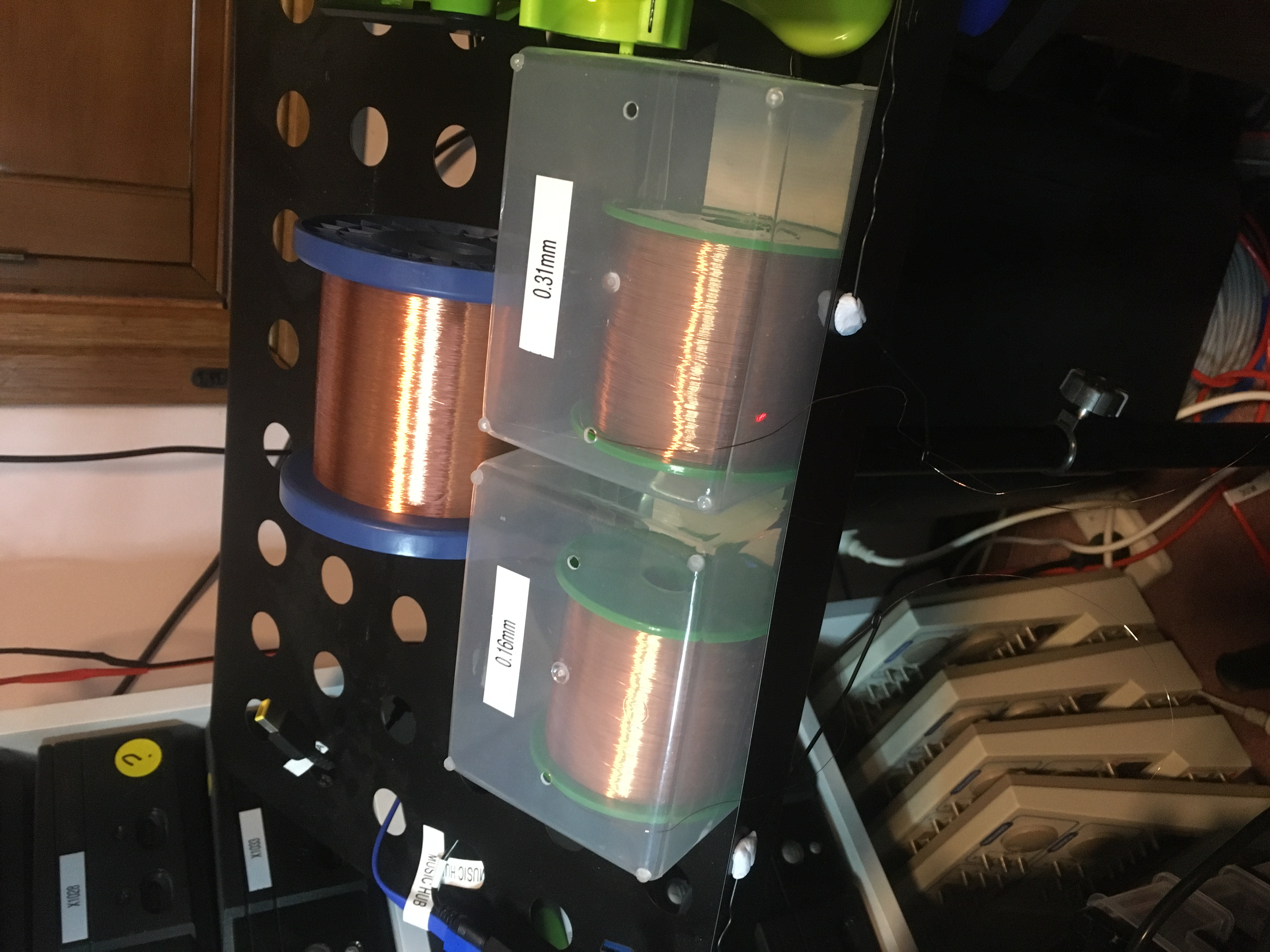
Thanks to my mate Bruce from Branchus Creations and his wire size suggestions I got a bunch of bodge wire for doing PCB repairs, being 1KG Enameled Copper Winding Wire 0.05 0.06 0.1 0.13 0.2 0.4 0.8 0.5mm 0.65 1.0 1.4 1.3mm Cable Magnet Wire Winding Wire Coil red. I got:
It would have been more convenient for me if the 0.07mm wire had have been on a smaller roll like the other two, but we can’t have everything. I’ve been thinking I might get some sort of wire rack, but I’m not sure where I would keep it.
I wasn’t sure exactly how I would go about cleaning enamel off the wire for soldering, so I asked ChatGPT, which gave me a number of options:
I think what I will actually try is just tinning the ends with my soldering iron and some fresh solder and see if that will burn off just a little bit of enamel on the tips, leaving me with a tinned wire I can easily solder into place.
I found a good video that shows how to crimp a JST PHD connector: JST Connector Crimping. When crimping these JST connectors I use my ENGINEER PA-09 crimping tool. I use a 1.4mm crimp for the wire and a 1.9mm crimp for the insulation.
I’ve made arrangements to hang my Xbox Torx drivers (you need T10, T15, and T20 drivers, I got this HORUSDY 12-Piece Magnetic Torx Screwdrivers Set, S2 Steel T5 – T40 Torx Star Screwdrivers with Demagnetizer and Storage Pouch) on the side of my table:
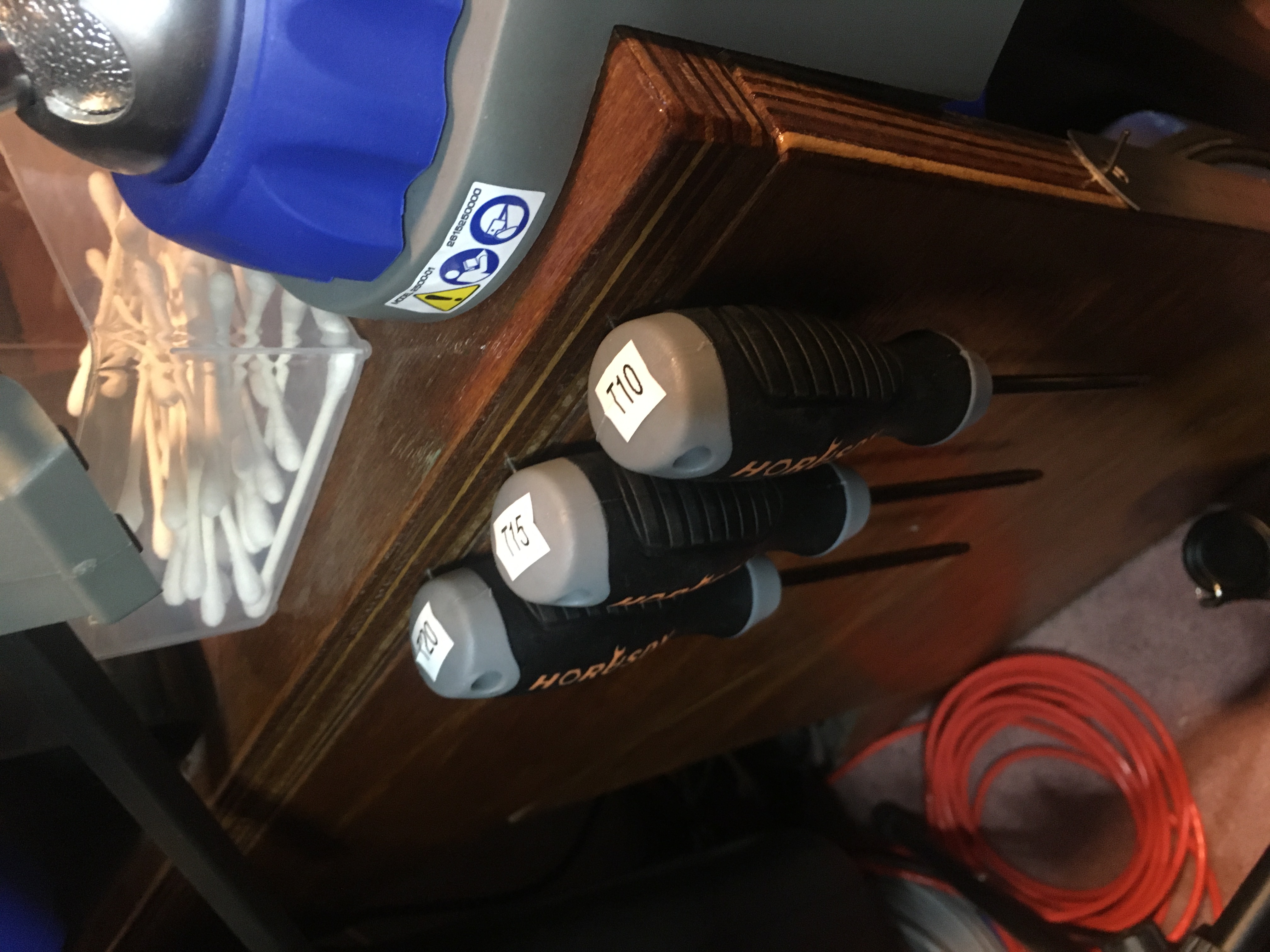
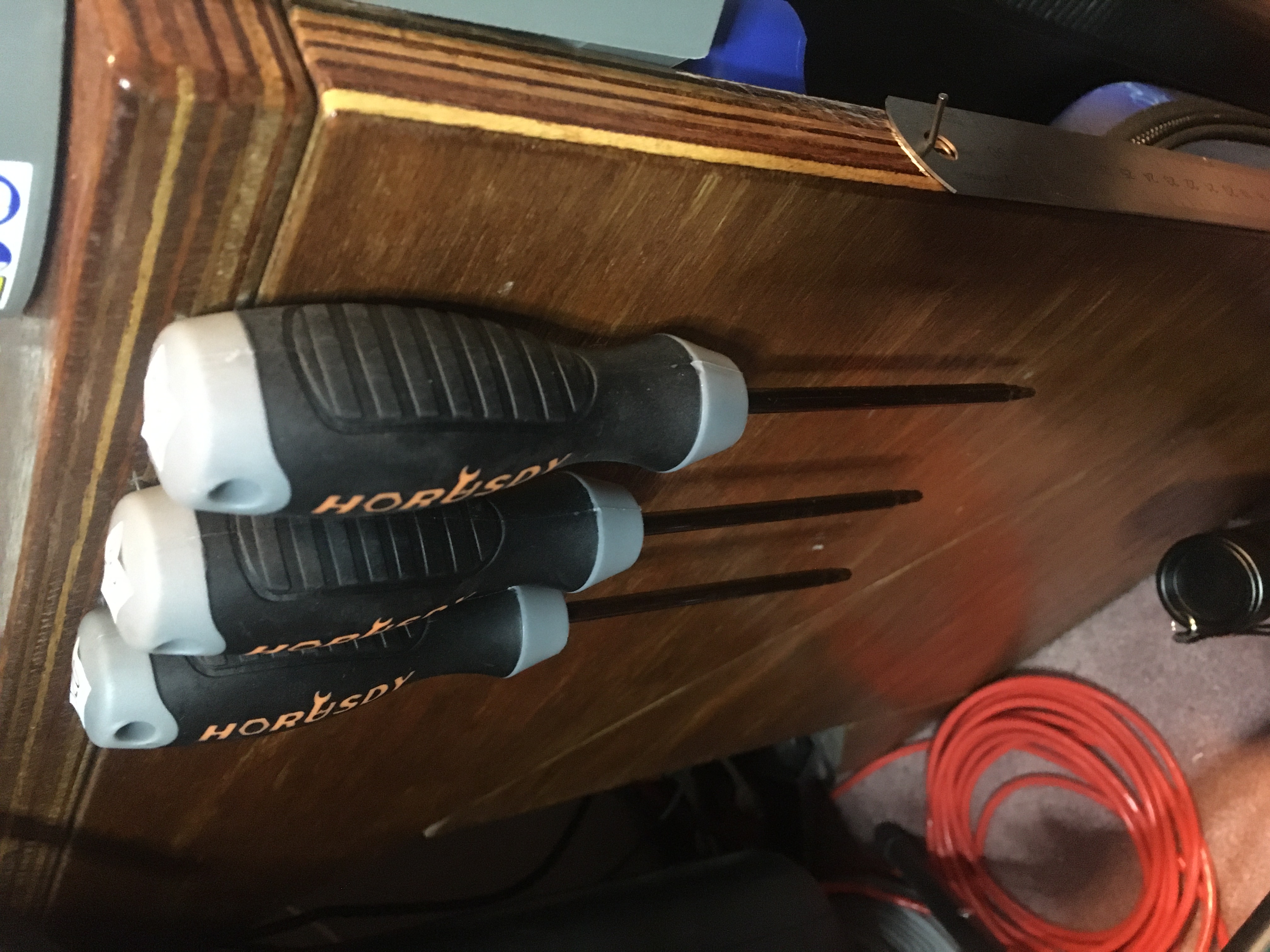
I used 30mm nails but they’re not quite long enough, so I got some 40mm ones which I will upgrade to when they arrive.
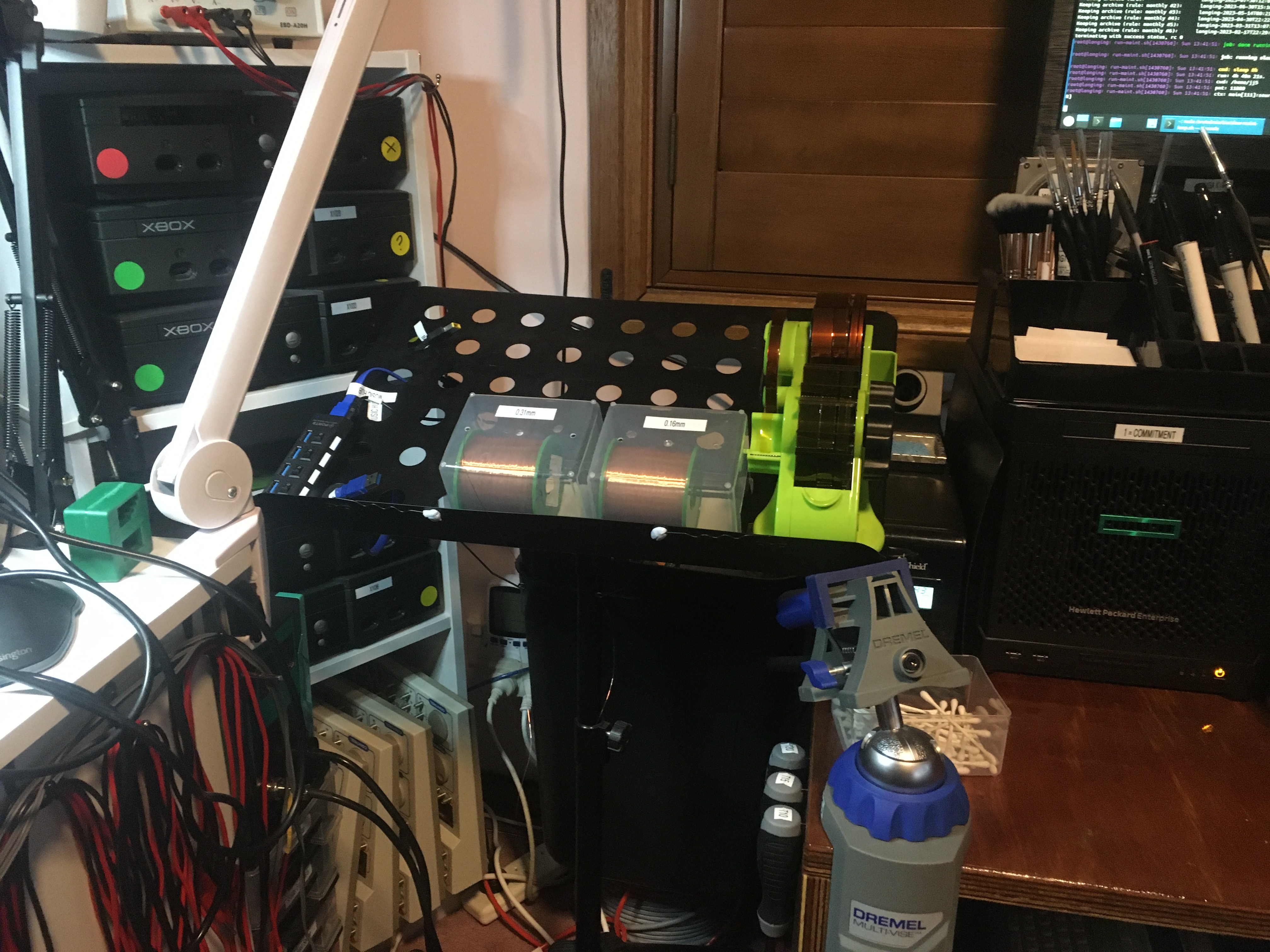
Also I moved my old laptop off the music stand to make room for my bodge wire and Kapton tape dispenser:
Have been researching Xbox DVD capacitors.