My favourite software development anecdote of all time: Brian Valentine, senior vice president of the Windows Division, during the development of Windows 2000 by a 4,200 strong team of developers: “Decisions in 10 minutes or less, or the next one is free.” — The Motivator Behind the Windows 2000 Development Team, February 16, 2000
Category Archives: Philosophy
The Hidden Half
I just finished reading The Hidden Half: How the World Conceals its Secrets. It’s about the limits to, and complexity of, theories about causation. I was going to say that it was “postmodern”, but I think instead I will say that it’s “ultramodern”.
In Praise of Idleness
Today I read In Praise of Idleness by Bertrand Russell. It’s an old essay about how we should all work less.
Stories
I think stories are so important, but here is a contrary idea: Be suspicious of stories | Tyler Cowen | TEDxMidAtlantic.
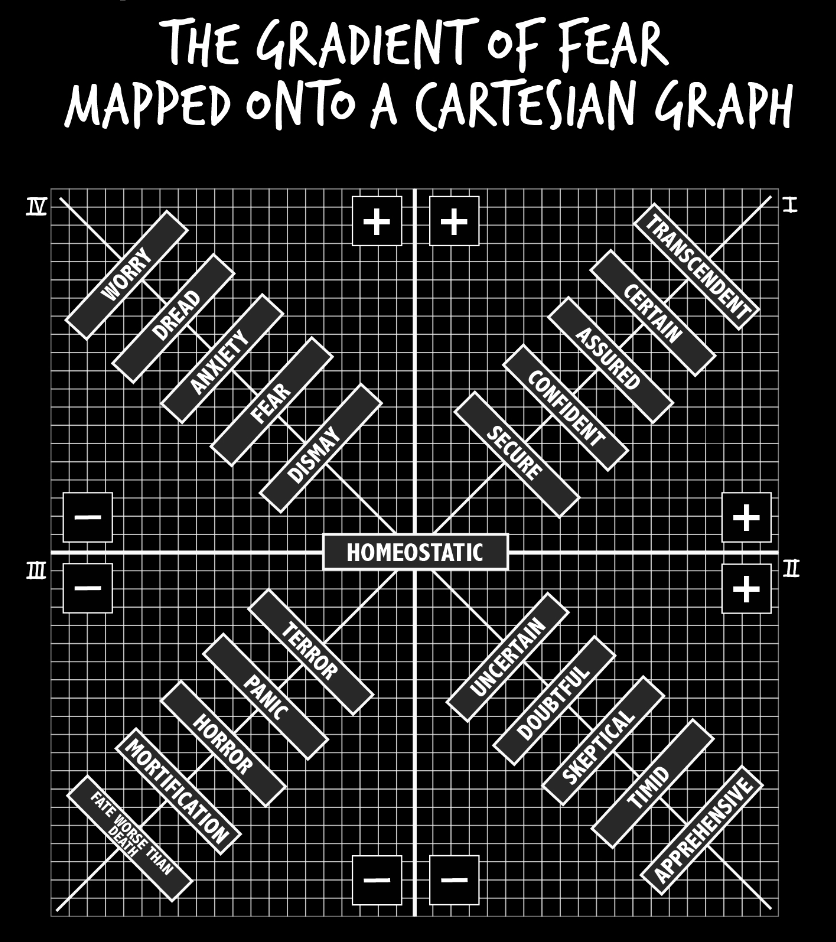
The Gradient of Fear
Mysticism and Morality
From 1.4.9. – Mysticism and Morality – Pt. 1:
Now, you see, I’m not talking about a philosophy, I’m not talking about a rationalization, some sort of theory that somebody cooked up in order to explain the world and make it seem a tolerable place to live in. I’m talking about a rather whimsical, unpredictable experience that suddenly hits people, and it includes this element of feeling the total harmoniousness of everything.
Some links
I watched SLAVOJ ŽIŽEK on the Desert of Post-Ideology and found the Open MIND Project.
Slavoj Žižek
Today I learned of Slavoj Žižek while reading my MEAP copy of Street Coder.
Big Ball of Mud
Reading about the Big Ball of Mud design pattern. Favourite quote:
There are good reasons that good programmers build BIG BALLS OF MUD. It may well be that the economics of the software world are such that the market moves so fast that long term architectural ambitions are foolhardy, and that expedient, slash-and-burn, disposable programming is, in fact, a state-of-the-art strategy. The success of these approaches, in any case, is undeniable, and seals their pattern-hood. People build BIG BALLS OF MUD because they work. In many domains, they are the only things that have been shown to work. Indeed, they work where loftier approaches have yet to demonstrate that they can compete.
Quote from John Stuart Mill
I happened upon this one today:
He who knows only his own side of the case knows little of that. His reasons may be good, and no one may have been able to refute them. But if he is equally unable to refute the reasons on the opposite side, if he does not so much as know what they are, he has no ground for preferring either opinion… Nor is it enough that he should hear the opinions of adversaries from his own teachers, presented as they state them, and accompanied by what they offer as refutations. He must be able to hear them from persons who actually believe them…he must know them in their most plausible and persuasive form.