Reporting in on vibe coding experience

I was chatting to some friends on IRC about my experience vibe coding so far. Figured I might as well take some time to check in about that. I suppose first I should say that I am definitely not an AI coding guru, I have pretty minimal experience with it so far.

On some of my computers I have vscode configured with Github Copilot which gives me some auto-complete type support using AI technology. This is sometimes useful and sometimes not. I am yet to use Claude in vscode.

Mostly when I’m vibe coding something I am using ChatGPT via its web interface. I have a “Plus” account with them that I pay for each month. Usually I will ask it to do something for me, it will give me a pretty useful response, then I might get it to tweak a thing or two, or I might edit myself for a few tweaks, and we’re done. Following are things I have done like this recently.

Times Tables Practice. This was an app that I got ChatGPT to help me write. You need a large monitor to view this, it won’t work on your phone. This actually evolved in stages. First I got the 15 x 15 grid on the left working, then the visualization in the middle, then the visualization on the right. It was pretty ugly integrating those bits and pieces, I just copied-and-pasted them into one big file but didn’t take any effort to make them mutually consistent. I have been debating myself about what I should have done here. Maybe I should have used separate JavaScript and CSS files for each major feature so it was clear which code was generated with each feature, or if I should do what I did and just paste it all into the same HTML file. I’m still not sure about that, but the mono-HTML file does work.

Mental Arithmetic Practice. These are practice questions mostly to help me learn my fifteen times tables, but they have simple addition and subtraction questions too. This was pretty much one shot, I asked ChatGPT to make it and I got this result pretty much on the first try. I needed to make a very small edit to make “Random” the default choice instead of “Addition”.

Arithmetic Practice. These are longer arithmetic practice questions which require a pen and paper to figure out. ChatGPT got this pretty much right first go, but I made some minor tweaks to improve legibility and the results when printing on A4 paper.

Thevenin Equivalent Practice. This was my first go at generating practice questions for Thevenin equivalent circuits. This wasn’t quite what I was after so I gave it anther go.

Thevenin Equivalent Practice v2. This was my second go at Thevenin equivalent circuit practice. The visualization as given is pretty shit and I kinda gave up on this. Now my plan is to work through example problems I found elsewhere on the internet: Thevenin & Norton practice problems.

So that’s three successful vibe coding projects and two failures.

Learning the Art of Electronics: 1L.7 Oscilloscope and function generator | In The Lab With Jay Jay

You can support this channel on Patreon: patreon.com/JohnElliotV

This post is part of my video blog and you can find more information about this video.

Silly Job Title: Spark Slinger. I am the Spark Slinger!

In this video we continue to work our way through Learning the Art of Electronics. In this video we finish 1L Lab: DC Circuits by learning how to use our oscilloscope and function generator.

We use the Rigol MSO5074 Mixed Signal Oscilloscope as our oscilloscope and we use the UNI-T UTG962E Signal Generator as our function generator.

Thanks very much for watching! And please remember to hit like and subscribe! :)

p.s. today I added slinger to my spell check.


Following is a product I use picked at random from my collection which may appear in my videos. Clicking through on this to find and click on the green affiliate links before purchasing from eBay or AliExpress is a great way to support the channel at no cost to you. Thanks!

Yum Cha Razor BladesThis is an image of the product.

Let’s go shopping!

The Highs and Lows of Oscillation | Project 10/30 | Maxitronix 30in1 | In The Lab With Jay Jay

You can support this channel on Patreon: patreon.com/JohnElliotV

This post is part of my video blog and you can find more information about this video.

Silly Job Title: Volt Vanguard. I am the Volt Vanguard!

In this video we do the 10th project from the Maxitronix 30in1 Electronics Project Lab Kit: The Highs and Lows of Oscillation.

The spreadsheet with our measurements is here: Maxitronix-30in1-10.ods.

We use the Rigol MSO5074 Mixed Signal Oscilloscope to measure the period of our circuit’s oscillations.

We use the UNI-T UTi260B Thermal Imager to check the thermal properties of our circuit. There was nothing exciting to see.

We use the Carpenter Mechanical Pencil to take notes.

We use the Kaisi S-160 45x30cm Repair Mat as our workspace.

Thanks very much for watching! And please remember to hit like and subscribe! :)

p.s. today I added Rigol and Imager to my spell check.


Following is a product I use picked at random from my collection which may appear in my videos. Clicking through on this to find and click on the green affiliate links before purchasing from eBay or AliExpress is a great way to support the channel at no cost to you. Thanks!

Yum Cha CrowbarThis is an image of the product.

Let’s go shopping!

Learning the Art of Electronics: 1L.6 I versus V for some mystery boxes | In The Lab With Jay Jay

You can support this channel on Patreon: patreon.com/JohnElliotV

This post is part of my video blog and you can find more information about this video.

Silly Job Title: Code Warrior. I am the Code Warrior!

In this video we continue to work our way through Learning the Art of Electronics. In this video we continue with 1L Lab: DC Circuits and investigate two mystery boxes.

The values we measure in this video are available in this spreadsheet: LAoE-01L.6.ods.

We use the METCAL PS-900 Soldering Station for soldering.

We use the AiXun H314 Hot Air Gun for heat shrink.

We use the Riden RD6006 Bench Power Supply to provide test voltages of 0.1 V through 10 V.

We use the EEVblog BM2257 Digital Multimeter to measure current.

We use the EEVblog BM036 Digital Multimeter to measure current.

We use the Fluke 17B+ Digital Multimeter to measure voltage.

We use the Brother P-Touch D210 Label Maker to make labels.

We use the WilliamKlein Music Stand to hold the text book.

We use the Carpenter Mechanical Pencil to make notes.

We use the Hakko CHP 3C-SA Precision Tweezers for tweezering.

We use the Plato Model 170 Wire Cutter to cut, cut, cut.

We use the Kaisi S-160 45x30cm Repair Mat as our workspace.

Thanks very much for watching! And please remember to hit like and subscribe! :)

p.s. today I added to my spell check.


Following is a product I use picked at random from my collection which may appear in my videos. Clicking through on this to find and click on the green affiliate links before purchasing from eBay or AliExpress is a great way to support the channel at no cost to you. Thanks!

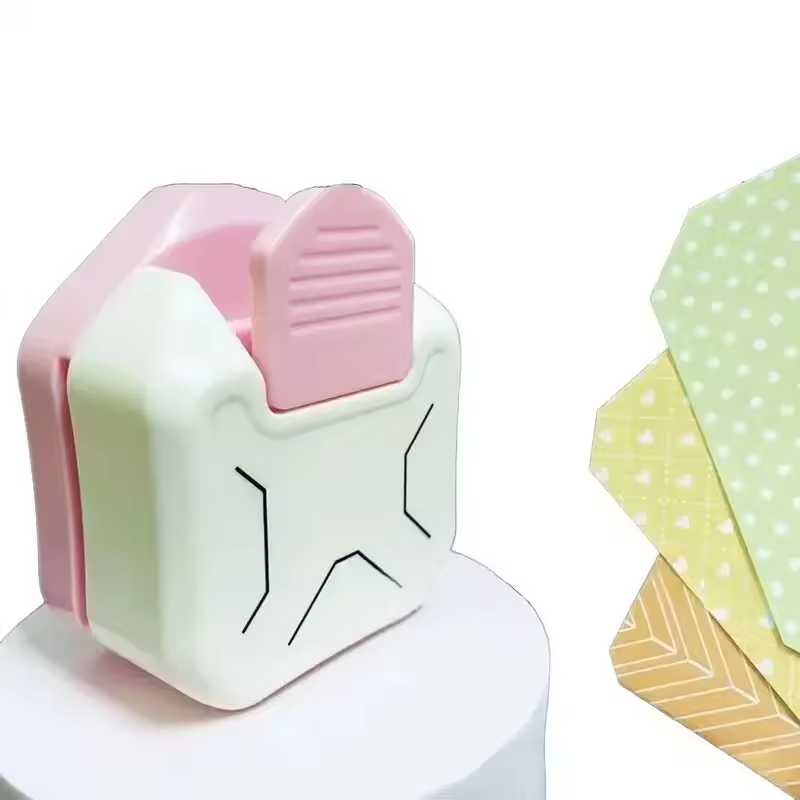
Yum Cha Corner CutterThis is an image of the product.

Let’s go shopping!