So I finally used the DALL·E service for the first time.


So I finally used the DALL·E service for the first time.
ChatGPT 4
User:
can a Directed Acyclic Graph always be put into the plane?
ChatGPT:
A Directed Acyclic Graph (DAG) can usually be drawn in the plane, but whether it can be drawn without any edges crossing (i.e., as a planar graph) depends on the specific structure of the DAG.
A graph is considered planar if it can be embedded in the plane without any of its edges crossing each other. Not all graphs are planar. The planarity of a graph is generally tested using Kuratowski’s Theorem, which states that a finite graph is planar if and only if it does not contain a subgraph that is a subdivision of either the complete graph K5 (five vertices each connected to every other vertex) or the complete bipartite graph K3,3 (two sets of three vertices with every vertex of the first set connected to every vertex of the second set).
To determine whether a specific DAG is planar, one would typically either:
Therefore, while many DAGs can indeed be drawn in the plane without crossing edges, it’s not universally true for all DAGs; the specific structure and connectivity must be considered.
I just needed to make a note of this unironic statement which I read here:

Wow. On Wikipedia you can download a 1515 Latin translation of the Almagest: Claudius Ptolemaeus, Almagestum, 1515.
I was able to read this file on my Debian workstation after installing the package djview4.
Today I discovered Undocumented LTspice while reading Introduction to LTspice – MIT (PDF).
Today I happened upon this ATTiny85 Quick Reference.
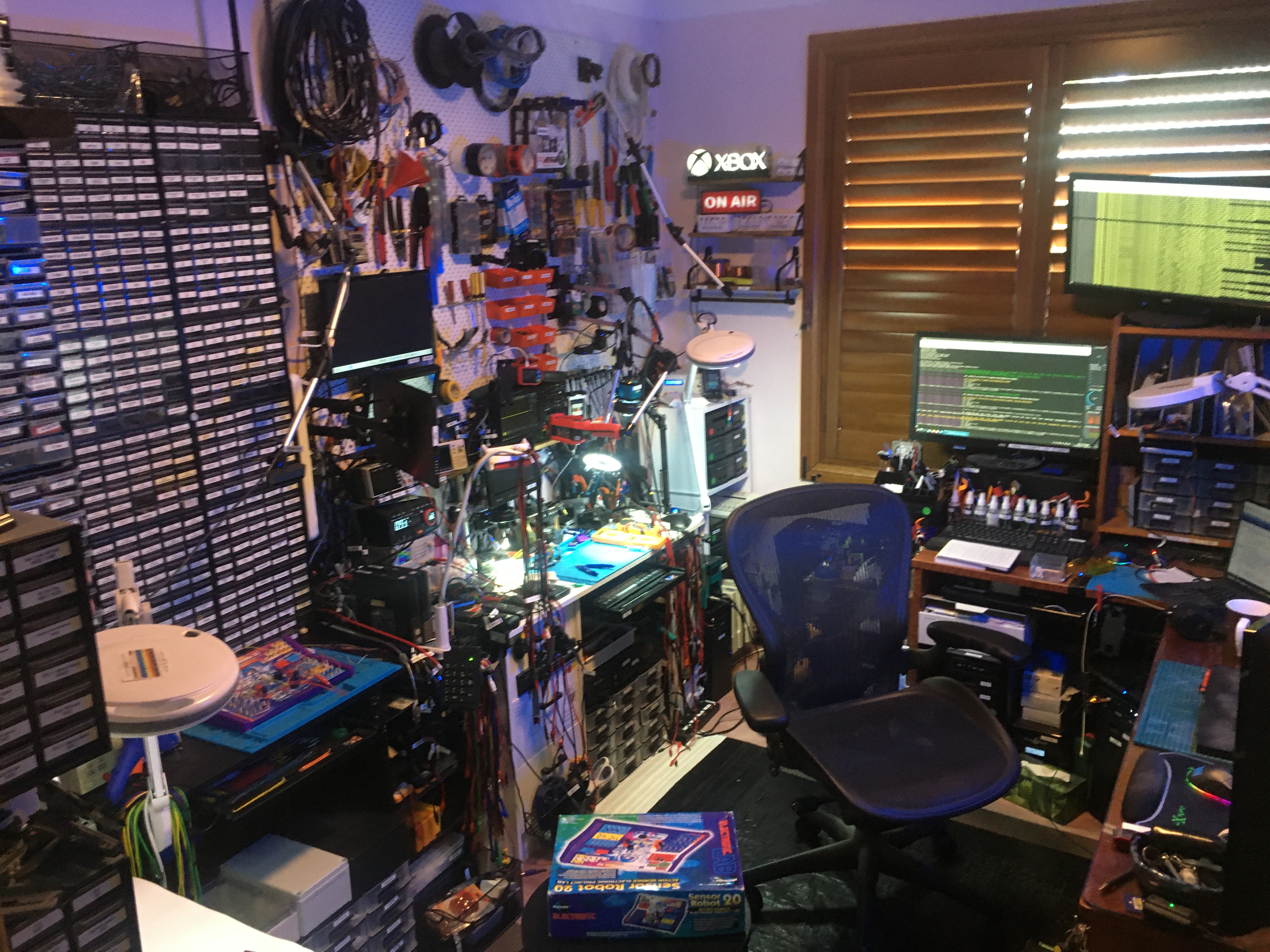
Just wanted to take a happy snap of the lab today. All is flux. All is temporary.
On an EEVblog video I learned about ChipQuik Alloy which has a low melting point for removing difficult SMT components with a soldering iron.
Today I stumbled upon: https://www.jbctools.com/. They have some nice looking kit! JBC was mentioned by Dave Jones in EEVblog #596 – World’s Cheapest Soldering Station – Yihua 936 so I went looking.
Note to self: I was watching EEVblog #378 – Dumpster Diving Teardown Repair and EEVblog #763 – Dumpster Plasma TV Bad Cap Repair and Dave Jones says Nichicon make high quality capacitors. Apparently Panasonic, Nippon Chemi-Con, Rubycon, and Cornell Dubilier are also good.