I found myself over here today: Timeline of human evolution. It’s striking how recent most of the things we take for normal are, and how different things used to be. I wonder what our future is?
Timeline of human evolution
Reply

I found myself over here today: Timeline of human evolution. It’s striking how recent most of the things we take for normal are, and how different things used to be. I wonder what our future is?
I don’t believe I am autistic, but I have a few friends who are on the spectrum, and I am occasionally assumed to be based on the manner of my expression (it’s an occupational hazard I suppose). Anyway I did have some interest in reading Dave Plummer‘s book Secrets of the Autistic Millionaire: Everything I know about Autism, ASD, and Asperger’s that I wish I’d known back then… This is just another one of those things on my very long list of things I would very much like to read but for which I just don’t have the time.
A quick search for arduino fuses programming turned up a bunch of results:
This evening I fell into a gameboy rabbit hole:
Spent AU$50 picking up some bits and pieces during AliExpress’s latest sale.
A while back now I had the good fortune to pick up Silicon Chip‘s library of old books. I didn’t get *all* of them, but I did get quite a lot.
I was thinking that as part of my In The Lab With Jay Jay videos, in future, I will tell you about one of these old books during the introduction to the video.
Here are Hixie‘s parting remarks: Reflecting on 18 years at Google.
Man my chromium browser has been giving me a lot of grief lately. Two times so far I needed to reboot to fix the problem. This is the third time and rebooting is always such a hassle. :(
-------------------
Thu Nov 23 20:20:54 [bash:5.2.15 jobs:0 error:0 time:0]
jj5@charisma:/home/jj5
$ chromium
[1123/202056.945777:ERROR:elf_dynamic_array_reader.h(64)] tag not found
[1123/202056.945823:ERROR:elf_dynamic_array_reader.h(64)] tag not found
Trace/breakpoint trap (core dumped)
-------------------
I got an email from one of the marketing people from PCBWay who said they could offer me free PCB printing services in exchange for a review of their service on my blog. I am very happy to do that!
Today I signed up for an account over here: https://www.pcbway.com/Member/Login/
The signup process was extremely painless: email address, password, terms of service, privacy policy, done.
(Note: I am not a lawyer, but I did read the ToS and privacy policy, and basically they claim the rights to your design files for various purposes and might transfer your data over an insecure network. I think these services are fine for hobbyists dealing with open hardware, but if you’re a commercial entity dealing with higher value intellectual property or larger volumes you might like to get legal advice before engaging.)
After logging in I got an email confirmation code emailed to me. I updated my account settings including my basic information and contact information so they know where to ship my PCBs. In exchange for my having filled out my full profile they gave me US$35 worth of vouchers with various terms (e.g. minimum spend).
I then used their shared project service to search for a 555 timer circuit that would meet my requirements. I found this one: Educational 555 Board.
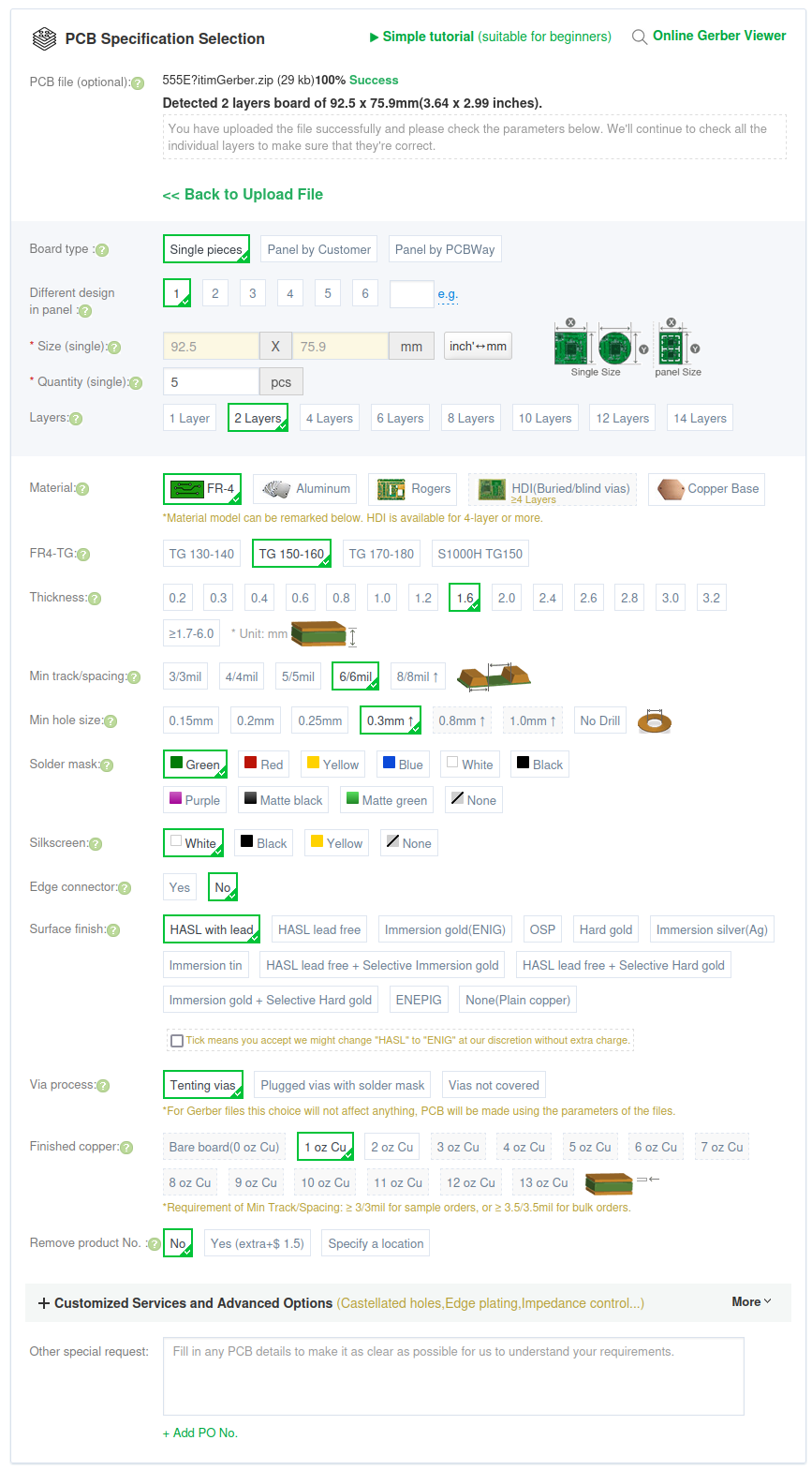
I clicked “Add to cart” and accepted all the defaults (shown below) on my order for 5 PCBs. So far I am a happy customer! (Update: as part of our sponsorship deal PCBWay covered the shipping costs too! I was a bit worried they might ask me to cover the shipping, but they included it, which was super excellent, especially as the shipping was about five times as much as the boards themselves!)
I’m just getting started with PCB printing. I expect that in future I will do much more of it. I have been working my way through PCB design with KiCad – updated for KiCad 7 to learn how to design PCBs using KiCad. Apparently there is a PCBWay Plug-In for KiCad, so that might be something worth checking out.
When my PCBs from PCBWay arrive I will make a video of me putting together the 555 timer circuit and then using it to test my IC test probes. Stay tuned for that one!
Man I was just browsing some old code and found myself over here: https://www.progclub.org/pcrepo/pccipher/trunk/php/src/pccipher_blowfish_64.php.
I committed that code in 2012, that’s 11 years and 4 months ago. Wow. Seems like yesterday. How time flies!