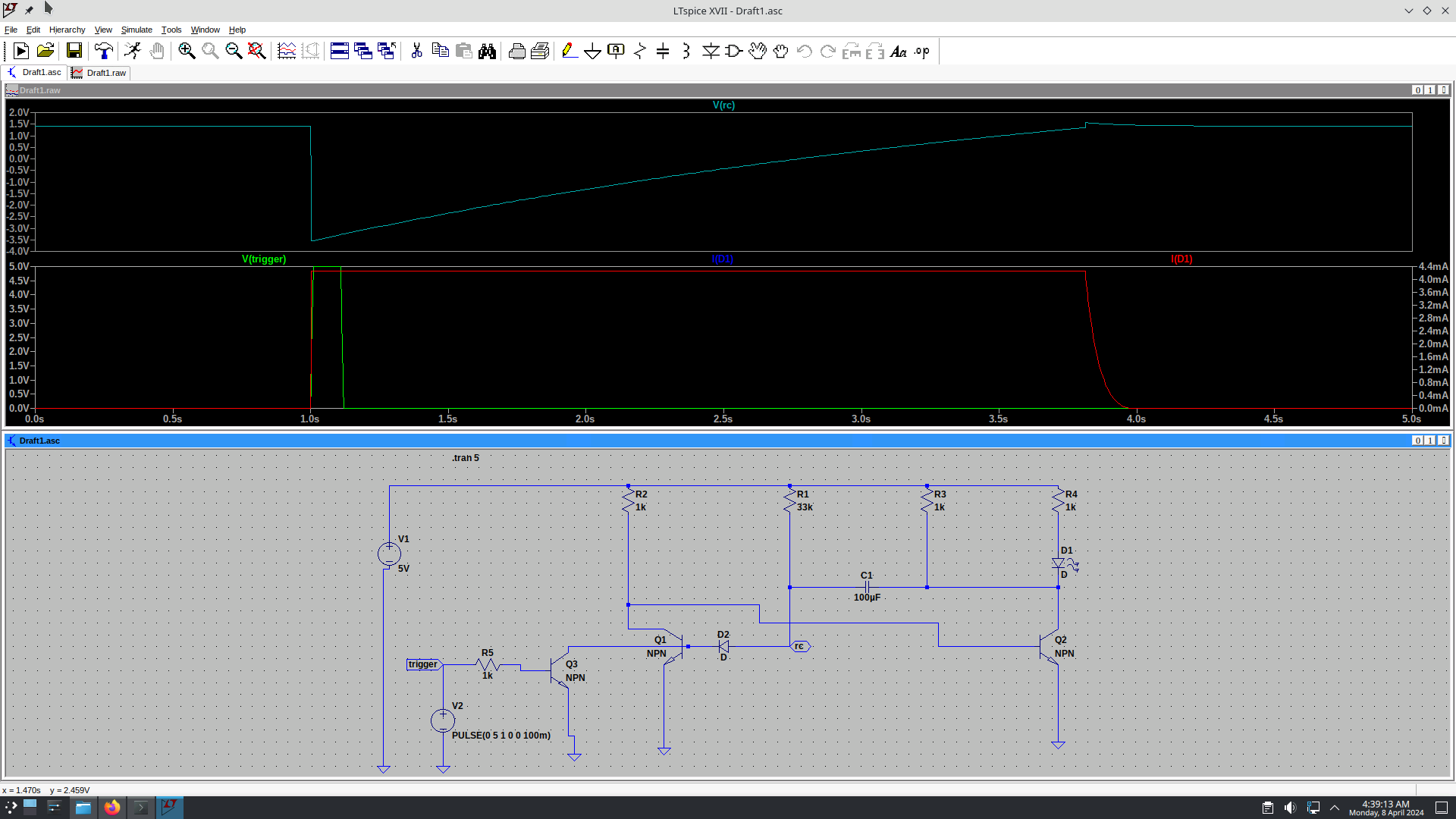
Today I created and ran my first SPICE simulation using LTspice! Super big thanks to my mate @Zero999 for helping me along the path. I installed on my Debian 12 (bookworm) electronics workbench ‘insight‘ using these instructions which I stole from here.
Category Archives: Diary
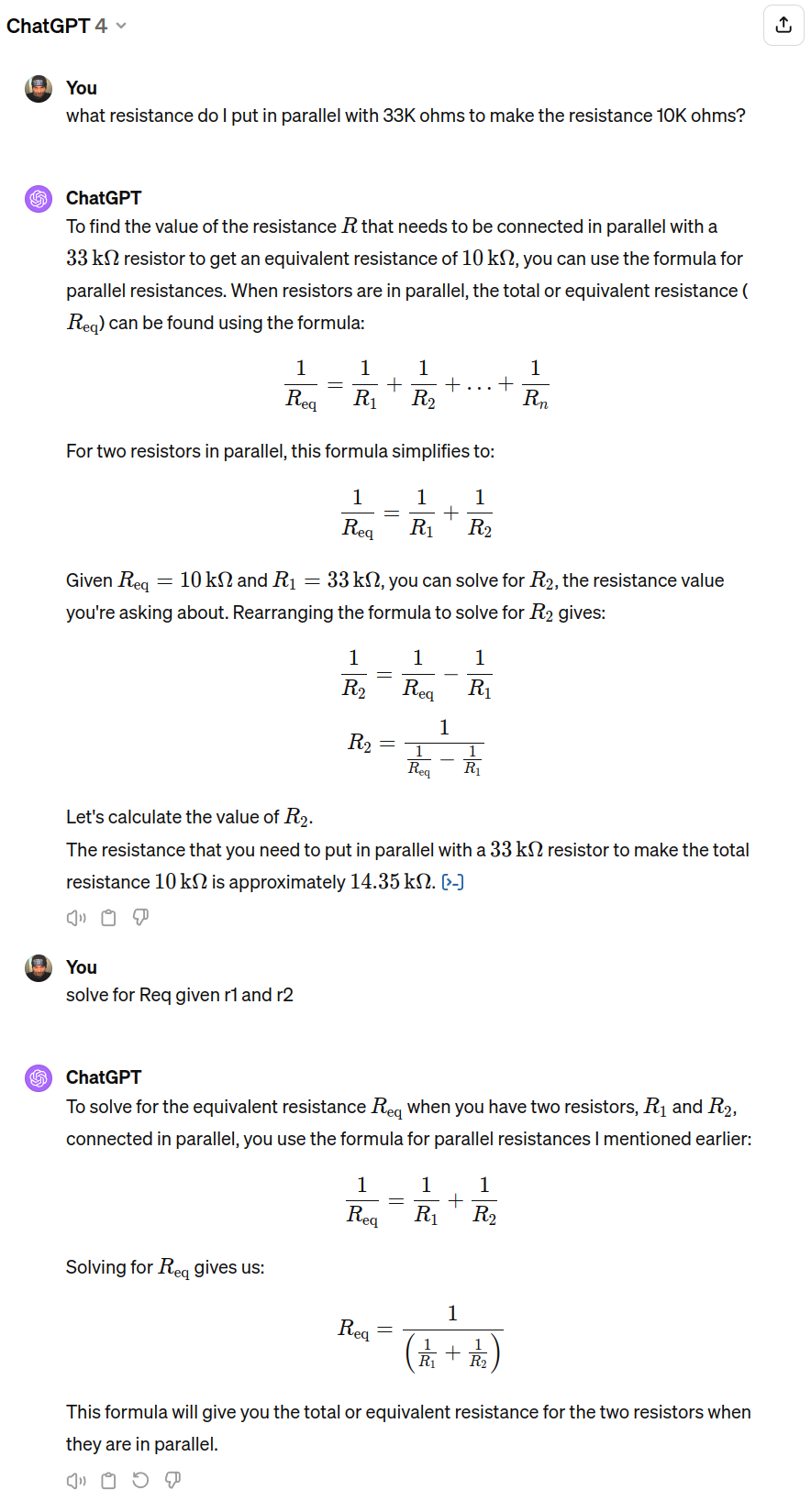
ChatGPT4 calculating resistance values
Gah!
I am way behind on my videos for In The Lab With Jay Jay, but it’s not for lack of trying! I’ve recorded the video for project 9 of the Maxitronix 20in1 something like five times now, but I still can’t release it because the circuit will not work as advertised. It’s suppose to be a demo of a monostable multivibrator, which is also known as a one-shot multivibrator, but the circuit isn’t working the way that a monostable multivibrator is supposed to work. I’m still in the process of debugging it. I think the problem is a problem with instructions and not my implementation (the instructions are fairly low quality and unreliable in my experience so far), but I haven’t arrived at the bottom of this one yet. I will continue to try and solve this conundrum tomorrow.
ChatGPT 4 on Indian cuisine
User: tell me about Palak Paneer
Palak Paneer is a popular vegetarian dish from the Indian subcontinent, particularly in North Indian cuisine. It’s a creamy and flavorful dish that combines palak (spinach) and paneer (a type of fresh cheese) in a richly spiced curry sauce. The dish is known for its vibrant green color, smooth texture, and delicious taste. Here’s a bit more about it:
Ingredients
- Spinach (Palak): The base of the sauce, blanched and pureed to give the curry its characteristic green color and nutritional boost.
- Paneer: Indian cottage cheese, which is cubed and either fried or added as is to the curry. Paneer adds a rich, creamy texture and protein to the dish.
- Spices and Aromatics: Commonly used spices include cumin seeds, turmeric, coriander powder, garam masala, and fresh ginger and garlic. These spices provide depth and complexity to the flavor.
- Cream or Yogurt: Used to add richness and smooth out the flavors. Some versions use tomato for a bit of acidity and color contrast.
Preparation
The preparation of Palak Paneer involves several steps:
- Blanching the Spinach: Spinach is quickly boiled and then plunged into ice water to retain its vibrant green color.
- Making the Curry Base: Aromatics and spices are sautéed to release their flavors, followed by the addition of spinach puree.
- Adding Paneer: Paneer cubes are added to the spinach curry and simmered until they are soft and have absorbed the flavors of the curry.
- Finishing Touches: The dish is finished with cream or yogurt to add richness and sometimes adjusted for seasoning with salt and a sprinkle of garam masala.
Serving
Palak Paneer is traditionally served with flatbreads like naan or roti and can also be enjoyed with rice. It’s a staple in Indian restaurants worldwide and is appreciated for its comforting taste and nutritious profile, being rich in iron from the spinach and protein from the paneer.
Nutritional Value
Palak Paneer is considered a healthy option due to the high content of spinach, which is rich in iron, vitamins A and C, and fiber. Paneer adds protein to the dish, making it a balanced meal. However, the nutritional value can vary based on the amount of cream or oil used in preparation.
This dish is a beautiful example of Indian culinary tradition, blending rich flavors, textures, and colors into a delicious and visually appealing meal.
User: what do you mean “fresh cheese”?
“Fresh cheese” refers to cheeses that are not aged or matured as part of their production process. Unlike aged cheeses, which can develop complex flavors and textures over time, fresh cheeses are meant to be consumed shortly after they are made. They are characterized by their soft texture, mild flavor, and high moisture content. Here are some key features of fresh cheese:
- Texture: Fresh cheeses tend to be soft and moist. Some are creamy and spreadable (like ricotta or cream cheese), while others can be firmer but still tender (like paneer or mozzarella).
- Flavor: These cheeses typically have a mild, sometimes slightly tangy or sweet flavor. The taste is more about the freshness and quality of the milk used rather than the fermentation or aging process.
- Aging: There is minimal to no aging process involved. Fresh cheeses are usually consumed within a few days to a couple of weeks after production.
- Uses: Fresh cheeses are versatile and can be used in a wide range of dishes, from salads and sandwiches to pizzas and desserts. They are also often enjoyed on their own or with a simple accompaniment of fruits or bread.
Paneer, the cheese used in Palak Paneer, is a perfect example of fresh cheese. It is made by curdling milk with a food acid (like lemon juice or vinegar) and then pressing the curds to form a firm block. Paneer is cherished for its ability to absorb flavors while maintaining its shape and texture, making it an excellent addition to various dishes in Indian cuisine.
User: tell me about Lamb Saag
Lamb Saag is a rich and flavorful dish from the Indian subcontinent that combines tender pieces of lamb with saag, a term used in Indian cuisine to refer to leafy green vegetables such as spinach, mustard greens, or a mix of greens. This dish is a variation of the traditional Saag, which is often prepared with paneer (cheese) or potatoes for vegetarian versions. Lamb Saag brings the unique, deep flavors of lamb meat into the mix, offering a hearty and satisfying meal. Here’s a closer look at this delicious dish:
Ingredients
- Lamb: Typically, boneless lamb is cut into bite-sized pieces. The lamb is marinated and then cooked until tender, making it the star of the dish.
- Greens: Spinach is the most commonly used green in Lamb Saag, but mustard greens, collard greens, or a mix can also be used. The greens are usually blanched and then pureed to form the base of the curry.
- Spices and Aromatics: Aromatic spices such as cumin, coriander, turmeric, garam masala, and fresh ingredients like garlic, ginger, and onions are used to build layers of flavor.
- Yogurt or Cream: To add richness and balance the flavors, yogurt or cream is often stirred into the curry towards the end of cooking.
Preparation
- Marinating the Lamb: The lamb pieces are marinated in a mixture of yogurt and spices to tenderize and infuse them with flavor.
- Cooking the Lamb: The marinated lamb is then cooked with onions, garlic, and ginger, along with additional spices until it’s browned and tender.
- Preparing the Greens: The greens are blanched, pureed, and then cooked with the lamb, allowing the flavors to meld together.
- Final Touches: Additional seasoning adjustments are made, and yogurt or cream is added to create a rich, creamy sauce.
Serving
Lamb Saag is traditionally served with flatbreads like naan or roti, as well as with rice. The dish is garnished with fresh herbs or a dollop of cream to enhance its appeal.
Nutritional Profile
Lamb is a good source of protein, iron, and other essential nutrients, making Lamb Saag a nutritious option. The greens add fiber, vitamins, and minerals to the dish. However, the nutritional value can vary depending on the amount of oil, cream, or yogurt used in the recipe.
Lamb Saag is appreciated for its combination of tender meat, nutritious greens, and the depth of flavor from the spices. It’s a testament to the versatility of Indian cuisine, where a single ingredient can inspire a myriad of delicious variations.
Extra Content #7: The SCSI Bus and IDE Interface: Protocols, Applications and Programming
This post is part of my video blog: In The Lab With Jay Jay.
You can support this channel on Patreon: patreon.com/JohnElliotV
In this video I pull the floppy disk out of the cover of my copy of The SCSI Bus and IDE Interface: Protocols, Applications and Programming (2nd Edition).
I have this wonderful old book The SCSI Bus and IDE Interface: Protocols, Applications and Programming (2nd Edition). It was published in 1997 but is still available for purchase through Amazon.
The book comes with a floppy disk (that’s right: a floppy disk!). I had to buy a USB floppy disk drive to read it. I have made the content from the disk available in a tarball, here: scsi.tgz.
If you just want to read the files, those are here:
Following is a list of products I use which may appear in my videos. Clicking through on these links before purchasing from Amazon, eBay, or AliExpress is a great way to support the channel at no cost to you. Thanks!
Let’s go shopping!
New Book Teardown #3: Learning The Art of Electronics: A Hands-On Lab Course (2016) | In The Lab
This post is part of my video blog and you can find more information about this video on this show’s homepage which is here.
You can support this channel on Patreon: patreon.com/JohnElliotV
Silly Job Title: Master Planner
This video is part of the New Book Teardown feature of my video blog.
In this video I take a look at Learning the Art of Electronics: A Hands-On Lab Course by Thomas C. Hayes and Paul Horowitz published in 2016. The book has 1,140 pages and is a companion to The Art of Electronics 3rd Edition.
Some notes about things of interest we noticed in the book:
- Xilinx was an American technology and semiconductor company, now owned by AMD
- the Ebers–Moll model is useful for modelling Bipolar junction transistors
- Hysteresis is the dependence of the state of a system on its history
- Wien’s bridge is used for precision measurement of capacitance in terms of resistance and frequency
- Wilson current mirror is a three-terminal circuit that accepts an input current at the input terminal and provides a “mirrored” current source or sink output at the output terminal
- a Bessel filter is a type of analog linear filter named in reference to Friedrich Bessel who developed the mathematical theory
- the video about the 6502 I watched recently is: The 6502 CPU Powered a Whole Generation!
- the Cypress PSoC is a family of microcontroller integrated circuits by Cypress Semiconductor
- octopart.com
- learningtheartofelectronics.com
Thanks very much for watching! And please remember to hit like and subscribe!
Update Jan 2025: Hi there. You might be interested to know that the second edition of this book is due to ship in March 2025! Can’t wait! https://learningtheartofelectronics.com/
If you want to pre-order a new version you can do so here:
US: https://www.amazon.com/dp/1009535188
UK: https://www.amazon.co.uk/dp/1009535188
AU: https://www.amazon.com.au/dp/1009535188
Following is a product I use picked at random from my collection which may appear in my videos. Clicking through on this to find and click on the green affiliate links before purchasing from eBay or AliExpress is a great way to support the channel at no cost to you. Thanks!
Yum Cha Blue Spudgers![]() |
Let’s go shopping!
EEVblog #63 – Microchip PIC vs Atmel AVR
Today I stumbled upon some vintage Dave Jones which made me happy: EEVblog #63 – Microchip PIC vs Atmel AVR. :)
Make: AVR Programming
I am reading Make: AVR Programming: Learning to Write Software for Hardware and I found this excellent video: Programming AVR Microcontrollers in C – O’Reilly Webcast available from here: Beyond the Arduino: Programming AVR Microcontrollers in C.
The author’s github page is still operational: https://github.com/hexagon5un/AVR-Programming
Their website littlehacks.org is offline but still available via archive.org: https://web.archive.org/web/20160307235812/http://littlehacks.org/
Also there’s this really cool collection of projects over here: Cornell University ECE 4760 Designing with Microcontrollers Final Projects.
ISP vs ICSP
User:
ISP vs ICSP
ChatGPT 4:
When discussing programming and interfacing with microcontrollers, “ISP” and “ICSP” are two terms that often come up. Here’s a breakdown of what each means and how they compare:
ISP (In-System Programming)
- Definition: ISP refers to the ability to program a microcontroller while it is placed within the actual system or circuit where it will operate. This method doesn’t require the microcontroller to be removed from its application circuit for programming. It’s a very convenient way to update firmware or make changes to the program running on the microcontroller without needing to disassemble the system.
- Advantages: It enables easy updates and debugging since the microcontroller does not need to be removed. This can significantly speed up development cycles and make maintenance simpler.
- Usage: Common in many microcontrollers, including AVR, ARM, and others. It typically requires a few specific pins to be accessible for the programming interface.
ICSP (In-Circuit Serial Programming)
- Definition: ICSP is a form of ISP specifically using a serial interface to program the microcontrollers while they are installed in a circuit. It’s a subset of ISP with a focus on the serial communication aspect. This method is often associated with Microchip microcontrollers but is not exclusive to them.
- Advantages: The serial nature of ICSP means it usually requires fewer pins and can sometimes support lower voltage programming, making it suitable for a wide range of devices and situations. It’s particularly useful for devices where space and pin count are at a premium.
- Usage: Predominantly seen with Microchip’s PIC microcontrollers, though the concept applies broadly. Like ISP, it necessitates access to specific programming pins but often fewer than other methods.
Comparison
- Scope: ISP is a broader term encompassing any in-system programming technique, including serial, parallel, or any other method. ICSP is specifically about serial programming.
- Interface and Protocol: ICSP typically involves specific protocols and hardware interfaces tailored for serial communication. In contrast, ISP can use various protocols and interfaces depending on the microcontroller and the system’s requirements.
- Microcontroller Support: While many microcontroller families support ISP, ICSP is more commonly associated with certain brands or families, like Microchip’s PIC series.
In summary, ICSP is a specific form of ISP. The choice between ISP and ICSP often comes down to the specific requirements of the project, including the microcontroller being used, the available pins for programming, and the preferred programming method. Both aim to provide flexibility and ease of use for developers and engineers when programming microcontrollers within their final application environment.
New camera, woohoo!
I am pleased to advise that today my new Logitech BRIO 4K webcam arrived. I have installed it in the booth, and unlike the last one, this one actually works. The implication for me is less stuffing around when it’s time to record videos because I will no longer have to move one camera between two mounts, the cameras are static now.