This dude’s web site is fun: hobbydebraj. Unfortunately the link that took me there is 404ing now.
hobbydebraj
Reply

This dude’s web site is fun: hobbydebraj. Unfortunately the link that took me there is 404ing now.
I was reading HATS: Automated testing of homebrew amateur radios and I discovered this list of talks by my mate Raz.
I got my Rigol MSO5074 outputting to HDMI:
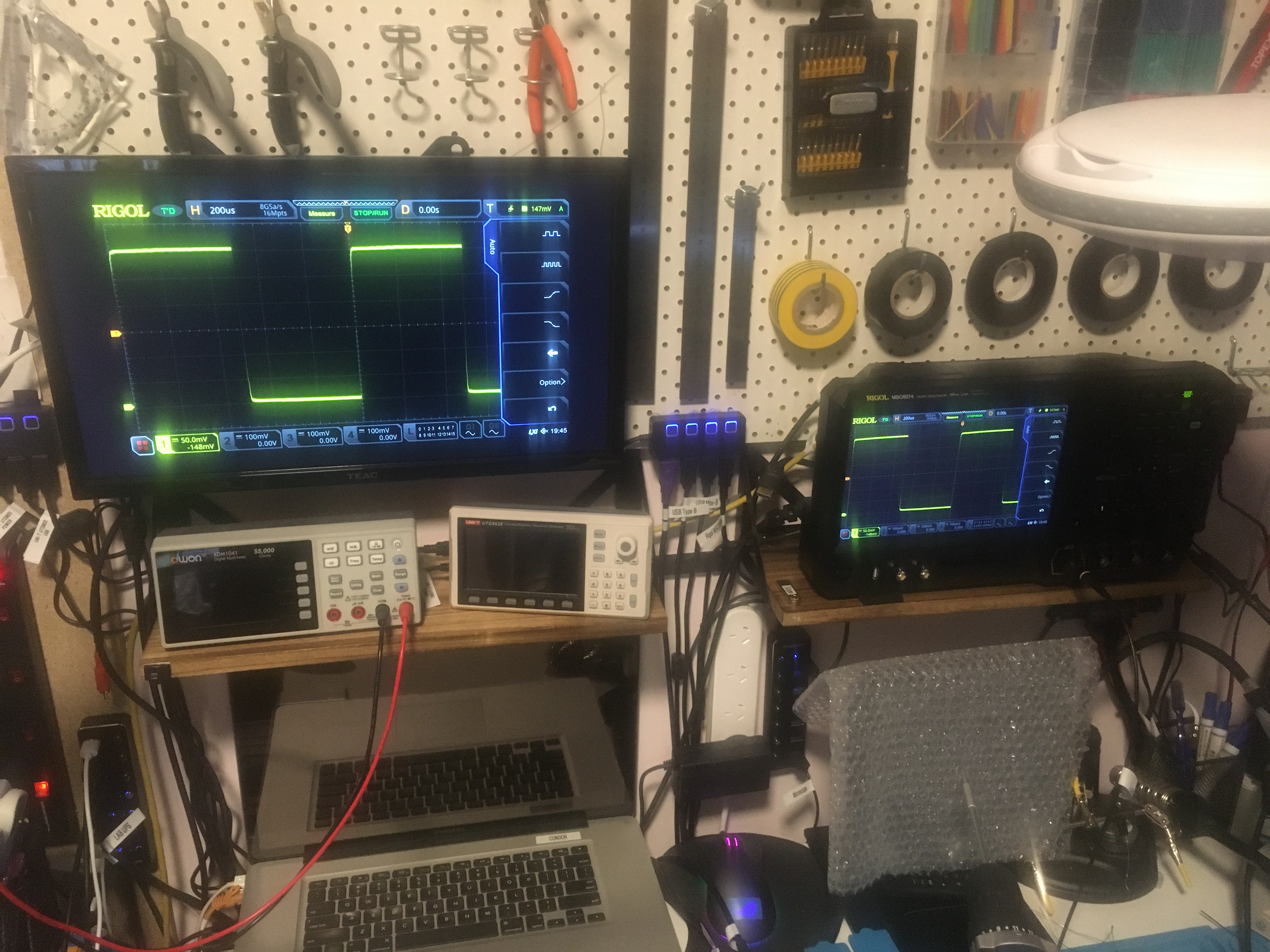
I can’t get it to work on my bigger HDMI monitor though, not sure why. Maybe the cable is too long? Maybe the signal is too low resolution? I don’t really know enough about HDMI to guess at the cause.
// 2022-09-18 jj5 – UPDATE: according to this there’s a known issue with HDMI that’s fixed with a firmware upgrade. Might have to look into that.
While watching TTT367 Embedded Systems and Rigol MSO5000 I learned of the Rigol DK-DS6000 Oscilloscope Demo Trainer Board which are for sale for US$231.
Before I splash out the big bucks for a DL3021 (or similar) I might start with a much cheaper option (there is also a case available).
I want to get a programmable electronic load. There are a bunch of options from Rigol. I’m thinking maybe a DL3021, such as this one available from AliExpress for $742.58 + shipping. Should probably do some research and see what is available from other manufacturers.
So I found tomtektest on YouTube. He has a series of videos on the Rigol MSO5000 (which is my scope).
I was reading Fast Fourier Transforms explained and I wanted to play along…
This code uses sine waves to approximate a square wave. The first is to the 11th harmonic, the second to the 9,999th…
So I recently completed the Udemy course: The Electronics Workbench: A Setup Guide. It was just some good introductory fun.
After watching the course lectures I decided that my electronics lab could do with a few more potentiometers, but apart from that, I already had most everything else.
I would like to get a better set of helping hands, though; the instructor had some nice ones which could be repositioned along the horizontal axis, but I can’t quite find such things on eBay.
Also I’d like to buy a desoldering gun, but I don’t have the funds just at the moment.
Most of the tools and parts recommended in the course are listed over here, but not those specific helping hands and not the desoldering gun (I’ve sent a message to the instructor asking about those two things).
I’m planning to buy these helping hands in the near future, assuming I don’t find something better.
I was searching for oscilloscope application notes and ended up finding the Pico Oscilloscope Range. If I was in the market for a PC based scope (I’m not) then I’d probably check these out. There’s some cool equipment there!
(Note: my MSO5074 scope has 8-bit vertical resolution, which is fairly standard, but if I ever find myself needing higher vertical resolution I will check out the
PicoScope® 4000 Series high resolution oscilloscopes.)
While checking out the Pico Tech site I found some other interesting articles:
And I also found Common Oscilloscope Applications.