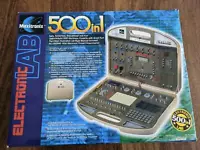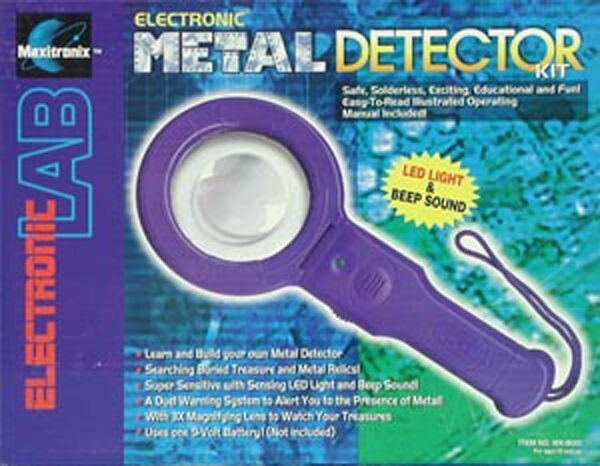
In this video I do the third Maxitronix 10in1 Electronic Project Lab project: Diode Experiment.
When I looked at the resistor on the bottom I thought it was red – brown – black – gold which would have been 21Ω but I think I misread brown and that was actually purple which would be 27Ω which stacks better with the two measurements I made both of which said 27Ω.
In the video we examine the forward voltage of our germanium diode and get various readings. Typically a germanium diode should be around 0.3V versus silicon diodes which are usually around 0.7V.
On the FNIRSI component tester the Ir is the “reverse current”, also known as the “leakage current”. This is the small amount of current which flows through the diode when it is reverse biased (that is, basically, connected the wrong way around).
I asked ChatGPT a few questions about diodes and their specifications which you can read here: Germanium Diode Forward Voltage if you’re at all interested in such things. Of course you should be doubly suspicious of anything you read on the internet. :)
The really amazing learning for me in this experiment was how hot the germanium diode got versus the lamp, which was so surprising. Just goes to show how good an idea it is to actually do experiments and measure things! The thermal imager we used was the UNI-T UTi260B.
Also I think I’m coming around to the view that an oscilloscope is a pretty poor voltmeter. My oscilloscope is an MSO5074 70MHz 4 Channel MIXED SIGNAL OSCILLOSCOPE and I love it but I think in future I will limit my use of the oscilloscope to situations where I’m actually dealing with some sort of oscillator. I think simple digital multimeters would have been better test equipment to use for the kinds of readings I was trying to take in this experiment.
I hope you enjoy the video. Stay tuned for the upcoming projects. If you’re interested in seeing them don’t forget to subscribe!
Also, if you’re interested in getting any of these Maxitronix kits yourself the best place I know to look is on eBay. Let me know if you find them somewhere else!
Thanks very much for watching! And please remember to hit like and subscribe!
Following is a product I use picked at random from my collection which may appear in my videos. Clicking through on this to find and click on the green affiliate links before purchasing from eBay or AliExpress is a great way to support the channel at no cost to you. Thanks!
I found the following four videos on the AlphaPhoenix channel explaining various aspects of the propagation of electricity, which goes some way to explaining how the high impedance headphone might work in my 10in1 2/10 project.
Man. I would really like to own a scope which could measure signals at 1GHz or more. Like this RIGOL DS70504 which can do 5GHz. The only problem is the price tag: AU$52,928.99. :(
I ordered a bunch of SMD diodes from AliExpress (nine different types), and nine packages arrived, but they weren’t labeled. I tested everything to infer what I got, and they didn’t ship me what I ordered. My notes are here and the video of me doing all this is here.
I kept a note of the seller and will try to not order from them again. In the mean time I think I have filed the components that did arrive in the correct drawer.
Below are two happy snaps from this project. I guess on the bright side I got some practice doing SMD soldering and using my signal generator and my scope.
Oh, and I added a new item to my debugging notes, viz “is it plugged into the right socket?” (I had my output cable on the signal generator plugged into the wrong BNC connector on the device, that took some figuring out…)
I had an envelope full of SMD diodes arrive today. Three different types in three different sizes, so nine bundles. Unlabeled!
I’m not sure what they were thinking at the shop. I got them from here.
I managed to figure out that the ones marked ‘S4’ were the Schottky diodes (1N5819WS). I think the ones labeled ‘T4’ are the switching diodes (1N4148WS) and the ones labeled ‘T7’ and ‘A7’ are the rectifying diodes (1N4007), but I’m not sure of that yet.